Learning how to clean a carbon steel pan takes about ninety seconds a day: let it cool, wash it in warm water, dry it on the burner, and wipe on a paper-thin coat of oil. That loop is the whole job. The pan’s nonstick surface is not a coating you were given in the box, it’s a polymerized oil layer you maintain yourself, so how you clean it decides whether food releases or welds itself to the metal.
I’ve watched people scrub a healthy pan with steel wool because a blog told them soap was poison, then wonder why it turned gray and started sticking. The instinct is backwards. Most problems people blame on cleaning are heat problems or oil problems, and most of the aggressive cleaning advice out there came from cast iron rules that don’t apply here.
What follows is the routine I’d want if someone handed me a pan I’d never seen before: a short daily loop, an escalation path for stuck food, a way to handle light rust, and the handful of habits that keep a pan usable for decades. No oven required, no special products, no stripping.
Table of Contents
- What You Need
- Step-by-Step: How to Clean a Carbon Steel Pan
- How to Clean a Carbon Steel Pan After Every Use
- How to Remove Stuck Food Without Damaging the Seasoning
- How to Dry and Re-oil the Pan
- Common Mistakes
- Quick Care Tips
- Frequently Asked Questions
- Can I use dish soap to clean a carbon steel pan?
- How do I remove rust from a carbon steel pan?
- What oil should I use to maintain a carbon steel pan?
- Why does my carbon steel pan smell oily or smoky?
- Does a carbon steel pan need to be completely free of food residue?
- How should I store a carbon steel pan?
- Conclusion
What You Need
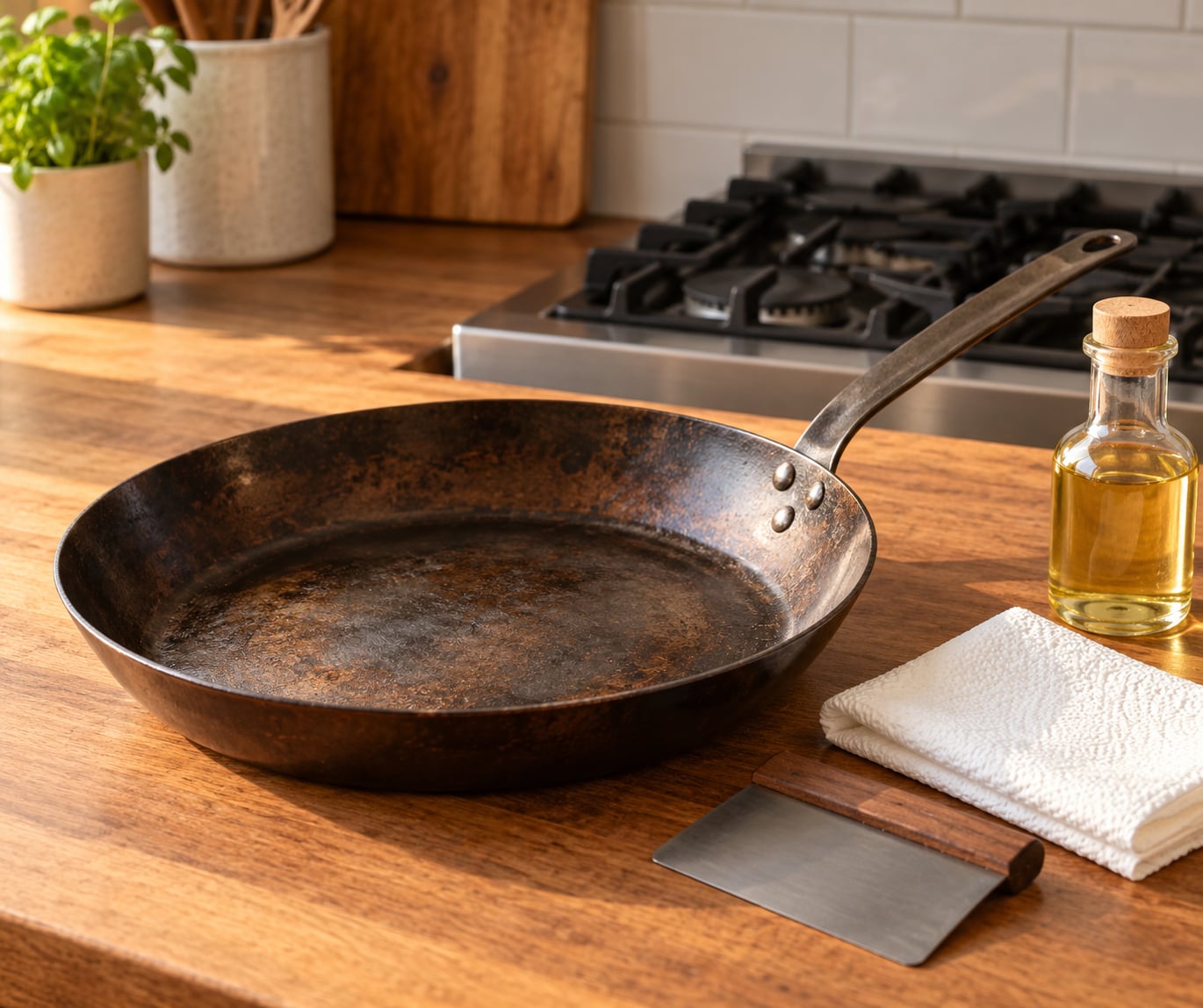
You need less than you think. Gather these before you start, and you’re set for years of use.
- A wooden or silicone spatula for lifting food before it bonds.
- A pan scraper or the back of a spoon for prying up stuck bits without gouging the seasoning.
- Warm water and a small amount of mild dish soap. Soap is not the enemy here.
- A non-abrasive sponge, nylon brush, or chain mail scrubber for the spots that need real work.
- Coarse kosher salt as an abrasive that costs almost nothing and rinses away clean.
- Paper towels for drying and for the final oil wipe.
- A high smoke point oil — canola, grapeseed, avocado, or flaxseed — kept near the stove.
For light rust you add one more thing: white vinegar or a lemon. The acid dissolves the oxide without touching the seasoning underneath.
A chain mail scrubber is a coiled stainless wire pad, and it’s the tool experienced carbon steel owners actually reach for. It’s harsh on seasoning and fine on steel, which makes it a bad choice for a weekly clean and a good one for a burnt patch or a full strip. Coarse salt does the same job more gently in most cases. You do not need a chain mail scrubber at all if you cook in your pan often and clean it after every use.
Substitutes are easy. A paper towel and a wooden spoon handle work for scrubbing. A splash of water boiled in the pan beats most of what people buy for stuck food. Skip steel wool, scouring powder, and any cleaner with bleach in it unless you’re deliberately stripping the pan to re-season it from scratch.
Step-by-Step: How to Clean a Carbon Steel Pan
Run the routine in order, and escalate only when a step visibly fails. Most pans never need step two or three more than once a month.
How to Clean a Carbon Steel Pan After Every Use
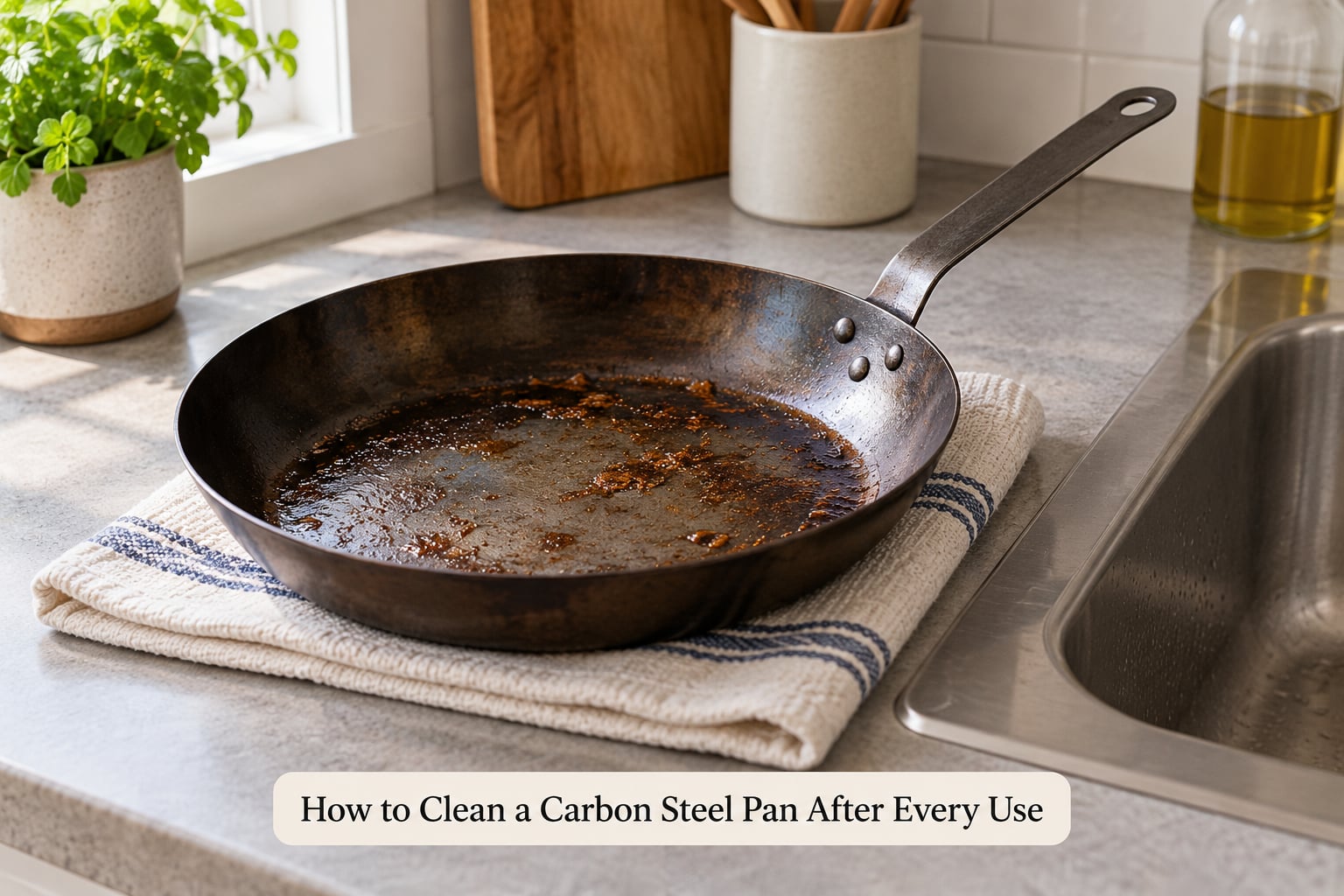
Let the pan cool until you can comfortably hold it, two to five minutes. This step exists for the metal, not your hands: cold water on a hot pan causes thermal shock, and a warped cooking surface is the one carbon steel damage you cannot scrub out.
While it’s cooling, scrape out the bulk of the food with a wooden spatula or scraper. You are after the loose pieces, not a spotless surface. Food left in a thin film is seasoning; food left in a thick crust is a problem.
Now wash it. Hold the pan under warm running water and use a small amount of mild dish soap with a non-abrasive sponge. A few drops, not a glug. Soap is safe: modern dish detergents are mild enough that a thin seasoning layer rebuilds within two or three uses, and a pan that has been washed with soap is not a ruined pan.
Rinse, then hold the pan up and look. If loose food is gone and the surface shows an even sheen, you’re finished. It does not need to be surgically spotless. If a dark ring of carbon remains, move to the stuck-food step below.
How to Remove Stuck Food Without Damaging the Seasoning
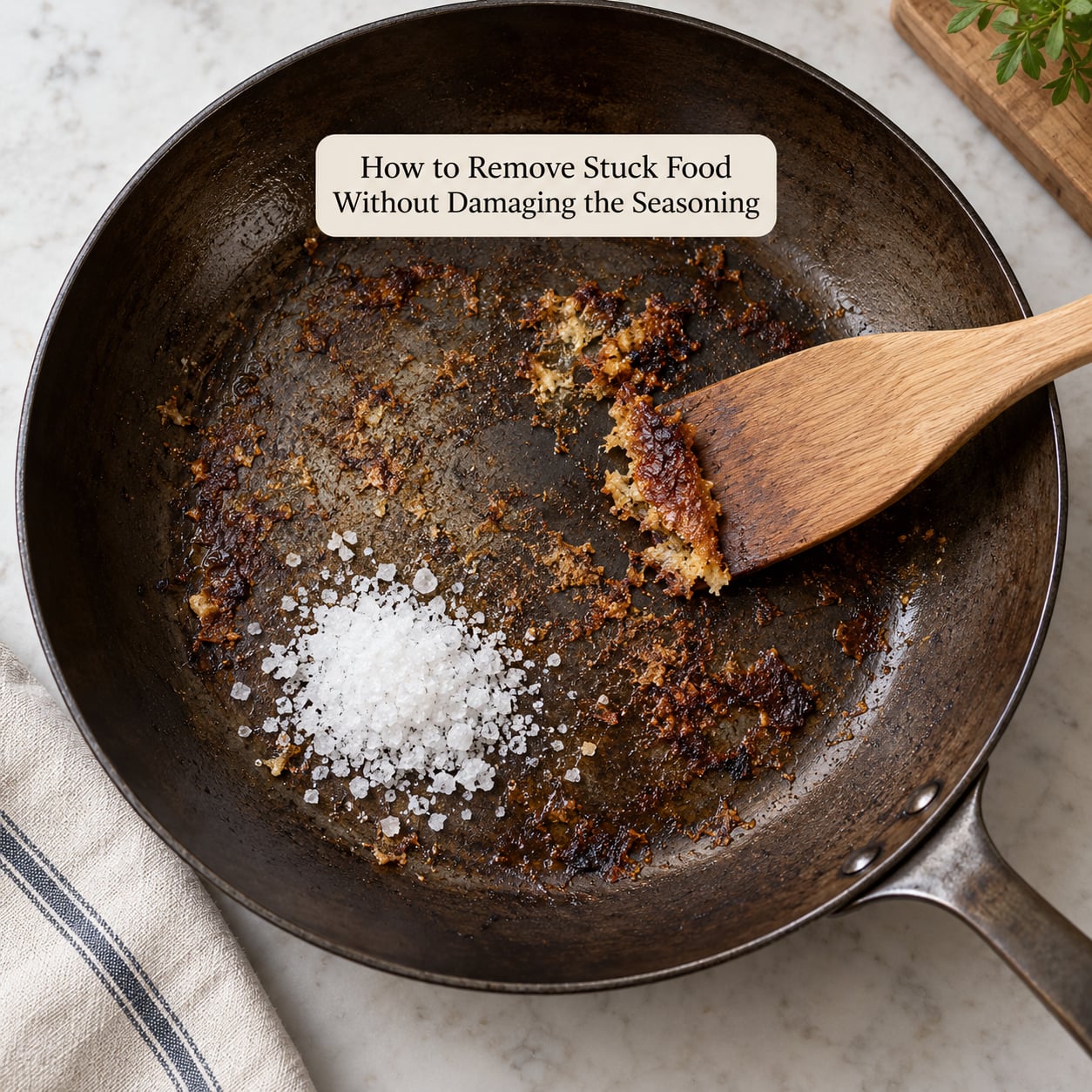
Start with the cheapest tool. Put a half-inch of water in the pan and bring it to a simmer on the stovetop for two or three minutes. The steam and bubbling loosen caramelized sugars and proteins. Scrape with a wooden spatula as it softens, then pour the water out.
Deglazing is the same idea, done as you cook: when fond is forming and you want it gone, pour in a splash of wine, broth, or water and scrape. Yes, it is fine to deglaze a carbon steel pan.
For what survives the simmer, use coarse kosher salt as an abrasive. Put a couple tablespoons of dry salt in the damp pan and scrub with a paper towel or your fingertips in circles. The salt does the cutting while the little crystals roll rather than dig. Rinse and dry.
Escalate to a chain mail scrubber only when salt has failed. Work in small circles, rinse immediately, and plan on a light oil afterward. Never use steel wool on a seasoned pan you intend to keep using. It takes the polymerized layer with it, and there is no cheap way to put that back.
If the food is burnt rather than stuck — black, flaky, and pouring smoke when you heat the pan — stop cleaning. A burn this size is a re-seasoning job, not a scrub job, and more scrubbing will only spread the mess.
How to Dry and Re-oil the Pan
Drying is the step people skip, and it’s the one that costs them the pan. Standing water on bare iron turns to rust, usually overnight.
Towel it dry first, thoroughly, with paper towels. Then set it on a burner over low heat for one to two minutes until the metal is hot enough that water would evaporate instantly. You can often hear a faint sizzle as the last of the moisture goes. Don’t rush this step by throwing cold water on a hot pan to quench it; that’s thermal shock again.
With the pan warm but not screaming hot, put a small amount of high smoke point oil on a folded paper towel and wipe the entire cooking surface, inside and out. Then wipe it again with a clean, dry section of the same towel until the towel comes back nearly free of oil. That second wipe is the whole technique. A visible film of oil is too much oil.
Too much oil is why pans go sticky. A sticky surface is a diagnosis, not a seasoning problem: the excess fat hasn’t polymerized, it just sits there. If your pan is sticky, wipe it hard with a dry paper towel, scrub it with coarse salt, and re-oil with a much lighter hand.
Common Mistakes
Almost every pan I’ve seen damaged was damaged by one of these five habits. Each has a simple correction.
Soaking the pan. A few minutes of warm soapy water is fine, but leaving a carbon steel pan submerged overnight dissolves the seasoning and invites rust through every waterline. The correction: wash it now, dry it now. If food needs a soak, use the simmering water method inside the pan instead.
Running cold water on a hot pan. The sudden temperature change warps the steel, and a warped pan cooks unevenly no matter how good the seasoning is. The correction: cool it on the burner with the heat off, or run warm water over a warm pan.
Scrubbing with steel wool or scouring powder. Fine on bare metal, destructive to a working polymerized layer. The correction: use salt for routine grime, chain mail for a full strip, and save steel wool for restoring a thrift-store pan you intend to re-season anyway.
Storing the pan damp. Even inside a dry cabinet, a thin film of water becomes orange speckles within a day or two. The correction: dry on the burner, then store with the lid set slightly ajar so air moves through.
Oiling heavily after every clean. This is the mistake people make in an effort to be careful, and it produces a sticky pan and a kitchen that smells like the oven. The correction: the wipe-until-clean technique, using barely more oil than a drop.
The last one is the opposite error: cleaning a pan that’s only lightly dirty and then deciding it needs re-seasoning. You would be throwing away seasoning that already works. Only strip a pan when it’s sticky, grey, flaking, or covered in burnt oil.
Quick Care Tips
A few habits shorten the whole routine. Cook in the pan often, because seasoning builds from repeated cycles of oil and heat, and an unused pan is a slow learner.
Avoid extreme temperature swings in either direction. Don’t put a screaming-hot pan under cold water, and don’t blast a cold pan on a high burner with cold oil in it.
Salt pans after acidic food. Tomato, wine, vinegar, and citrus are fine to cook in carbon steel, but a pinch of salt added to the food for the rest of that cooking session neutralizes the acid so it can’t strip seasoning during the meal.
For long-term storage, put a folded paper towel inside the pan, keep the lid slightly offset, and put the pan in a low-humidity cabinet. If you live somewhere genuinely damp, a silica gel packet in the cabinet is cheap insurance.
And clean the outside too. Splatter and smoke on the exterior of a pan are the first thing people notice, and a damp cloth with a drop of soap plus a stovetop burn-off handles it without touching the interior seasoning.
Frequently Asked Questions
Can I use dish soap to clean a carbon steel pan?
Yes, and you should stop worrying about it. Modern dish soap is mild enough that it strips very little of a healthy seasoning, and the layer rebuilds within two or three uses of cooking. A small amount of soap with a non-abrasive sponge is the fastest way to get loose grease off a pan. Only after a full strip, during an oven re-seasoning, is soap worth avoiding entirely.
How do I remove rust from a carbon steel pan?
Light rust comes off with acid. Pour in enough white vinegar or lemon juice to cover the spotted areas and let it sit for a few hours, then scrub with coarse salt or a nylon brush and rinse. Dry the pan on the burner right away. If the rust is pitted rather than surface-level, strip the pan fully and re-season it, because pitted metal traps moisture and will keep spotting.
What oil should I use to maintain a carbon steel pan?
For routine oiling, use something neutral and thin: canola, grapeseed, avocado, or an oil spray applied to a paper towel. For a from-scratch oven seasoning, flaxseed and grapeseed are excellent because they polymerize well. Avoid olive oil for routine care, especially extra virgin, because it smokes early and leaves a bitter film that makes a pan taste old.
Why does my carbon steel pan smell oily or smoky?
Most likely you left too much oil on the surface, and that film is slowly polymerizing instead of being wiped away. Wipe the pan hard with a dry paper towel, then scrub it with coarse salt and a drop of soap, rinse, dry, and oil it with a nearly dry towel. If the smell persists, bake the stripped pan at 350F for an hour with a very thin coat of oil to burn off the old residue.
Does a carbon steel pan need to be completely free of food residue?
No. A thin, even, dark film of seasoning is the surface you want, and scrubbing a pan down to bright metal after every meal throws that work away. Clean off loose food, a thick crust, and visible grease. Then stop. If the film is dark, smooth, and even, you have a pan that is ready to cook on again.
How should I store a carbon steel pan?
Completely dry, with a folded paper towel inside to absorb any ambient moisture, and with the lid set slightly ajar rather than sealed. Keep the pan in a cabinet away from the stove and dishwasher steam, and avoid a humid spot. Stacked pans are fine as long as the interior surfaces are dry, which is the whole point of the paper towel.
Conclusion
The rule that keeps a carbon steel pan alive is short: remove loose residue, dry the pan immediately, and leave a film of oil so thin you can’t see it. Do that every time and the pan gets better for years instead of worse.
Start with the daily loop and stay there. Reach for the simmering water and salt scrub when something is stuck, the vinegar when a rust spot appears, and save the oven for a pan that is genuinely ruined. Most of the trouble people have with carbon steel comes from cleaning a little too hard, too often, rather than too little.