To cut a recipe in half without guessing, divide every ingredient by two and then round each number to something you can actually measure. Learn two anchors and the math stops being math: 1 cup = 16 tablespoons and 1 tablespoon = 3 teaspoons. Convert the amount to tablespoons, halve it, convert back. Keep the oven temperature exactly as written, change the pan, and check doneness early. This whole method takes about ten minutes, most of it spent writing down numbers.
The reason this is worth learning properly is that almost every recipe is written for four to six servings. Cook for one and you either eat the same leftovers for four days or you guess at fractions with flour on your hands. Get the fractions right and a small batch tastes like the original instead of like a flat cake or a thin brownie.
A note on what this is not: you do not halve the oven temperature, and you do not halve the bake time. Those are the two changes people make that turn a small batch into a ruined one. More on that below.
Table of Contents
- What You Need
- How to Cut a Recipe in Half Without Guessing
- Convert Every Ingredient to a Measurable Amount First
- How to Cut a Recipe in Half: Divide, Then Round to Something You Can Measure
- Reduce Seasonings and Spices to a Little Under Half
- Adjust Baking and Cooking Conditions Instead of the Temperature
- Check the Result and Fix the Next Batch
- Common Mistakes
- Seven mistakes that turn a halved recipe into a bad one
- When You Should Skip Halving Entirely
- Frequently Asked Questions
- How do I divide an egg in half?
- How do I halve a recipe that calls for 3 eggs?
- How do I split a cake recipe in half?
- What pan size do I use for half a recipe?
- Do you halve the cooking time when you halve a recipe?
- Should I halve the spices and salt too?
What You Need
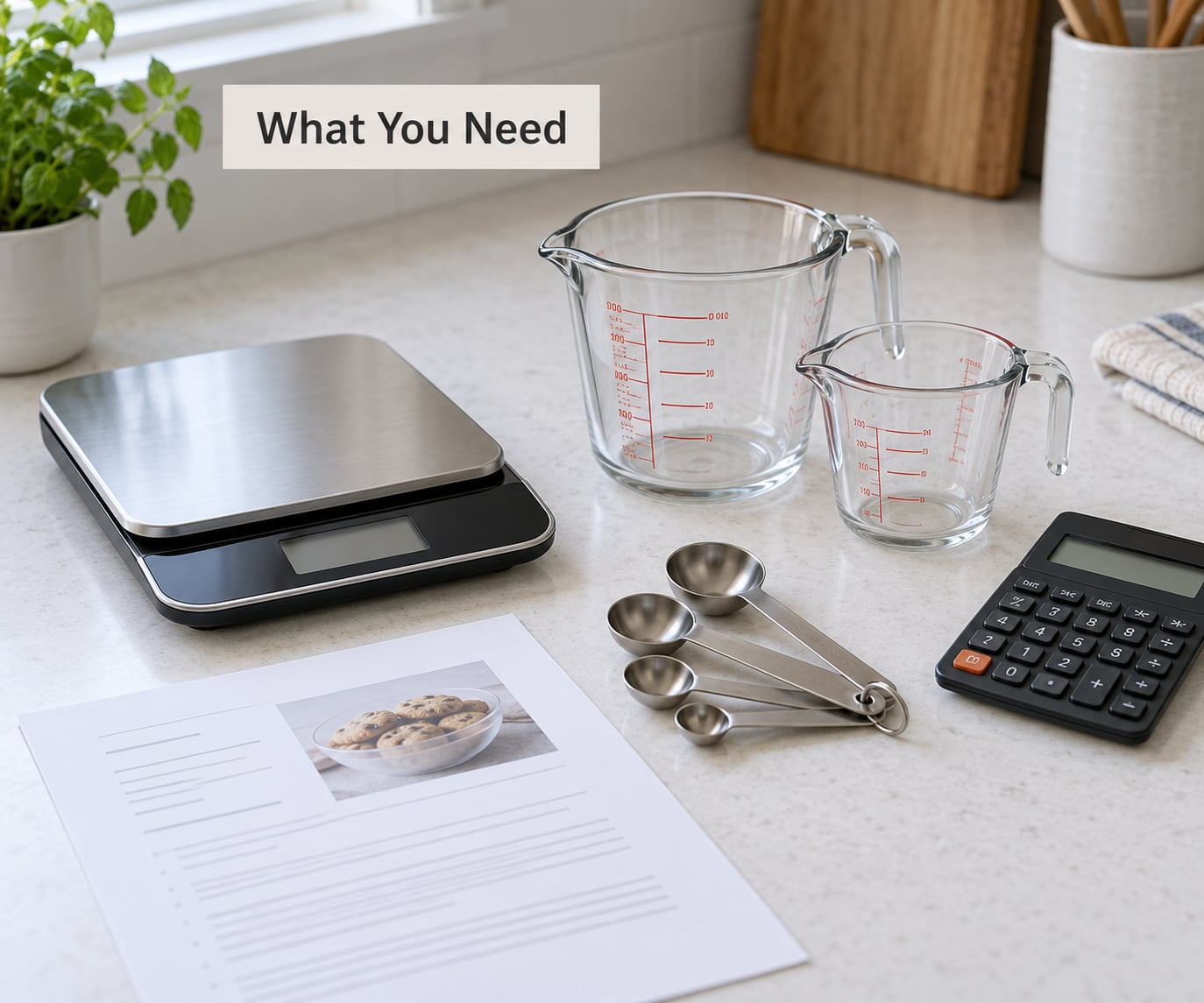
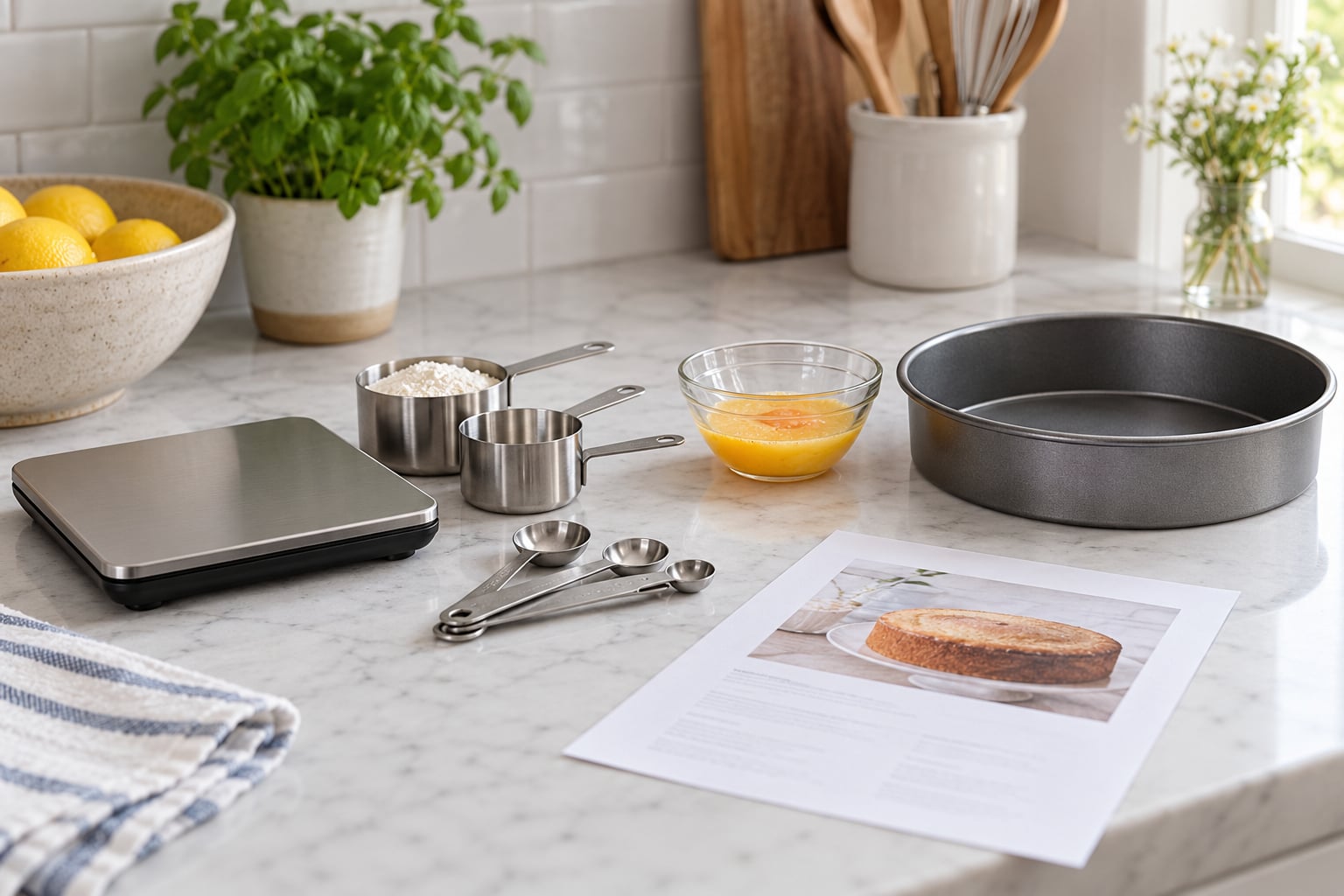
You need almost nothing. The list is short because the hard part is arithmetic, not equipment.
- The original recipe, written out in full. Print it or copy it into your notes. Scaling from a half-remembered list is how the leavening gets missed.
- Your phone or a calculator. Not because halving needs heavy math, but because 0.66 cup is easier to read than two-thirds of a cup while the butter is melting.
- Measuring cups and spoons you trust. A liquid measuring cup for wet ingredients, dry measuring cups for flour and sugar, and a set that includes a 1/8 teaspoon spoon.
- A digital kitchen scale, if you own one. This is the closest thing to no-guessing that exists. Halving a weight is dividing by two on the display, and flour measured by weight behaves far more consistently than flour scooped into a cup.
- A blank page. Write the new list before you start cooking. Prep measured for eight people and then cooked for two is how half the ingredients end up still in the fridge at midnight.
How to Cut a Recipe in Half Without Guessing
The method in one line: convert the measurement to a number you can halve cleanly, halve it, convert back, then round to the nearest real spoon or cup mark. Use the chart below as a lookup and you will not need to think about it at all.
| Original | Half | Quarter | Third |
|---|---|---|---|
| 1 cup | 1/2 cup | 1/4 cup | 1/3 cup |
| 3/4 cup | 3/8 cup (6 tbsp) | 3/16 cup | 1/4 cup |
| 2/3 cup | 1/3 cup | 1/6 cup | 2/9 cup |
| 1/2 cup | 1/4 cup | 1/8 cup | 1/6 cup |
| 1/3 cup | 1/6 cup (2 tbsp + 2 tsp) | 1/12 cup | 1/9 cup |
| 1/4 cup | 1/8 cup (2 tbsp) | 1/16 cup | 1/12 cup |
| 4 tbsp | 2 tbsp | 1 tbsp | 1 1/3 tbsp |
| 3 tbsp | 1 1/2 tbsp | 3/4 tbsp | 1 tbsp |
| 2 tbsp | 1 tbsp | 1/2 tbsp | 2/3 tbsp |
| 1 tbsp | 1 1/2 tsp | 3/4 tsp | 1 tsp |
| 1/2 tbsp | 1 1/2 tsp | 3/4 tsp | 1 tsp |
| 1 tsp | 1/2 tsp | 1/4 tsp | 1/3 tsp |
| 1/2 tsp | 1/4 tsp | 1/8 tsp | 1/6 tsp |
| 1/4 tsp | 1/8 tsp | 1/16 tsp | 1/12 tsp |
| 1/8 tsp | 1/16 tsp | 1/32 tsp | 1/24 tsp |
Thirds and quarters get approximate past 1/8 teaspoon. That is fine. A 1/16 teaspoon error in cayenne does not ruin anything, and a scale makes it a non-issue anyway.
Convert Every Ingredient to a Measurable Amount First
Whole numbers halve easily. 4 cups of flour becomes 2 cups, 6 eggs becomes 3. Trouble starts with odd counts and with amounts written as weights or awkward pieces.
For fractions, convert to the nearest tablespoon or teaspoon first. Half of 3/4 cup sounds bad until you rewrite it as 12 tablespoons, halve to 6, and land on a clean 3/8 cup. Half of 1/3 cup is 1/6 cup, which is 2 tablespoons plus 2 teaspoons, which you can measure.
| Cup amount | Tablespoons | Teaspoons | Milliliters | On a scale |
|---|---|---|---|---|
| 1/4 cup | 4 tbsp | 12 tsp | 60 ml | 0.25 |
| 1/3 cup | 5 tbsp + 1 tsp | 16 tsp | 80 ml | 0.33 |
| 1/2 cup | 8 tbsp | 24 tsp | 120 ml | 0.5 |
| 2/3 cup | 10 tbsp + 2 tsp | 32 tsp | 160 ml | 0.66 |
| 3/4 cup | 12 tbsp | 36 tsp | 180 ml | 0.75 |
| 1 cup | 16 tbsp | 48 tsp | 240 ml | 1.0 |
That last column is the one most guides skip. On a digital scale, halving 340 g of flour means typing in 170 g. Halving 200 g means 100 g. Halving 75 g means 37.5 g. Fractions only get awkward on a scale when the original number was awkward, and many recipe weights are round to begin with.
For weights already in the recipe, divide by two and stop. Do not convert grams to cups to halve them. That round trip loses accuracy for no benefit.
For awkward pieces, halve and then round to what you can eat or prep. Three cloves of garlic halved is 1.5 cloves, so use 1 large clove or 2 small ones and move on. A recipe calling for 1/2 a yellow onion becomes a small onion or half of the smallest one you have. Nobody is grading the garlic.
For eggs, which come up constantly, halve by volume or weight. Crack the egg into a small bowl or cup, beat it with a fork until the yolk and white are one uniform liquid, then measure. A large egg is about 3 tablespoons of beaten egg, so half of one egg is 1 1/2 tablespoons. One whole large egg weighs about 50 g without the shell, which makes half of it 25 g. Whisk first, then measure. Pulling a spoonful of yolk out of an intact egg gives you mostly yolk, and a cake that gets half its fat and all its leavening will not rise properly.
How to Cut a Recipe in Half: Divide, Then Round to Something You Can Measure
Division is the easy half. Rounding is where recipes quietly fail, because half of 1 tablespoon is 1 1/2 teaspoons, and half of 1/2 teaspoon is 1/4 teaspoon, and half of 1/3 teaspoon is a measurement nobody owns a spoon for.
- Teaspoons and tablespoons: round to the nearest 1/4 teaspoon. Half of 1 tsp is 1/2 tsp. Half of 1/2 tsp is 1/4 tsp. Half of 1/3 tsp is roughly 1/4 tsp, and nobody will ever know.
- Cups: round to the nearest 1/8 cup. That is 2 tablespoons, the smallest mark on most measuring cups and a fraction most people can eyeball reliably.
- Ounces and grams: round to the nearest whole gram for anything under 30 g, and to the nearest 5 g above that. Precision past that point costs nothing in the eating.
- Cups of dry flour: weigh it if you can. Scooping and packing changes the weight of a cup of flour by a surprising amount, and that error does not halve cleanly when you halve the recipe.
Then check the pan. This is the step that fixes the most common complaint I see, which is a halved brownie batch that comes out thin and underbaked in the middle: the recipe was halved, the pan was not. Batter depth drives both bake time and texture, so a smaller amount of batter in the original pan gives you a shallow layer with the middle still raw. Find a pan whose volume is close to half the original.
| Pan | Dimensions | Volume in cubic inches |
|---|---|---|
| 6-inch round, 2 inch deep | 6 x 6 x 2 | 57 |
| 8-inch round, 2 inch deep | 8 x 8 x 2 | 101 |
| 8-inch square, 2 inch deep | 8 x 8 x 2 | 128 |
| 9-inch round, 2 inch deep | 9 x 9 x 2 | 127 |
| 10-inch round, 2 inch deep | 10 x 10 x 2 | 157 |
| 12-inch round, 2 inch deep | 12 x 12 x 2 | 226 |
| 9 x 13 baking pan, 2 inch deep | 13 x 9 x 2 | 234 |
| Quarter sheet | 13 x 9 x 1 | 117 |
| Half sheet | 18 x 13 x 1 | 234 |
| 8-inch loaf, 2 inch deep | 8 x 4 x 2 | 64 |
Multiply the three numbers to get the volume. Half of a 9 x 13 pan is 117 cubic inches, which is exactly a quarter sheet pan, and half of a 9-inch round is about 64 cubic inches, which is an 8-inch loaf pan. Fill the smaller pan to roughly the same depth as the original rather than to the top, or you will have batter spilling over the sides.
Reduce Seasonings and Spices to a Little Under Half
Salt, pepper, chili, garlic powder and other potent seasonings go in at slightly under half, then you finish by tasting. Concentrated flavors like chili, vinegar, alcohol, extract and anchovy often taste out of balance when they shrink alongside the volume, because the fat and sugar that mute them have shrunk too. Start at about 40 percent of the original and add the rest at the end.
Baking powder and baking soda halve exactly. So do yeast and other leavening agents, within reason. Skipping or under-cutting the leavening is the single most common way a halved bake goes wrong, and the failure is a dense or flat result that no amount of extra baking powder later can fix.
Fats, liquids and bulk ingredients divide cleanly. Butter, oil, milk, water, stock, flour, sugar, oats, breadcrumbs and grated cheese all halve as written. Cheese is the one exception worth tasting: volume measured in cups does not halve as predictably as weight, because a cup of shredded cheddar and a cup of mozzarella weigh very different amounts.
Adjust Baking and Cooking Conditions Instead of the Temperature
Keep the oven temperature exactly as written. University of Wyoming Extension guidance on scaling recipes up or down makes the same point: changing the temperature to compensate for a smaller batch throws off the chemistry that makes the crust, the crumb and the caramelization happen in the right order. A halved cake baked 25 degrees cooler takes longer to set and bakes unevenly through the top.
Expect the smaller batch to cook faster, and start checking early. Less mass means the center reaches temperature sooner. Set a timer for roughly three-quarters of the original time and start testing from there.
For baked goods, use the toothpick test and pull it the moment it comes out clean or with a few damp crumbs. Wet batter clinging to the toothpick means more time. For meat, use a thermometer instead of guessing: 165°F for poultry, 160°F for ground meat, and 145°F for whole cuts and fish, with a three minute rest. These temperatures apply to a halved batch exactly as they do to a full one, and shrinking the pan does not shrink the required internal temperature.
For stovetop and slow cooking, lower the heat slightly if anything. A half batch of chili in a large pot can scorch on the bottom before the middle heats through, because there is less liquid and more exposed surface.
Check the Result and Fix the Next Batch
Taste before you serve and while the next batch is still hypothetical. A small batch is cheap to learn from.
If it is too salty, add more of the bland bulk ingredient, not sugar. If it is bland, salt it and wait five minutes before deciding again. If a bake is dense, the leavening was under-cut, and you halve it exactly next time. If a bake spreads flat or the middle is raw, the pan was too large or the batter too shallow, and next time you go down a size or shorten the bake by checking ten minutes early. If a sauce broke or reduced too fast, cut the heat and add a splash of liquid at the end.
Write the fixes on the recipe itself. I keep a pencil in the margin of the ones I cook often, and after two or three runs the recipe in that book is more accurate than the one I started with.
Common Mistakes
Seven mistakes that turn a halved recipe into a bad one
These come up over and over on baking forums, and most of them are the same mistakes in different clothes.
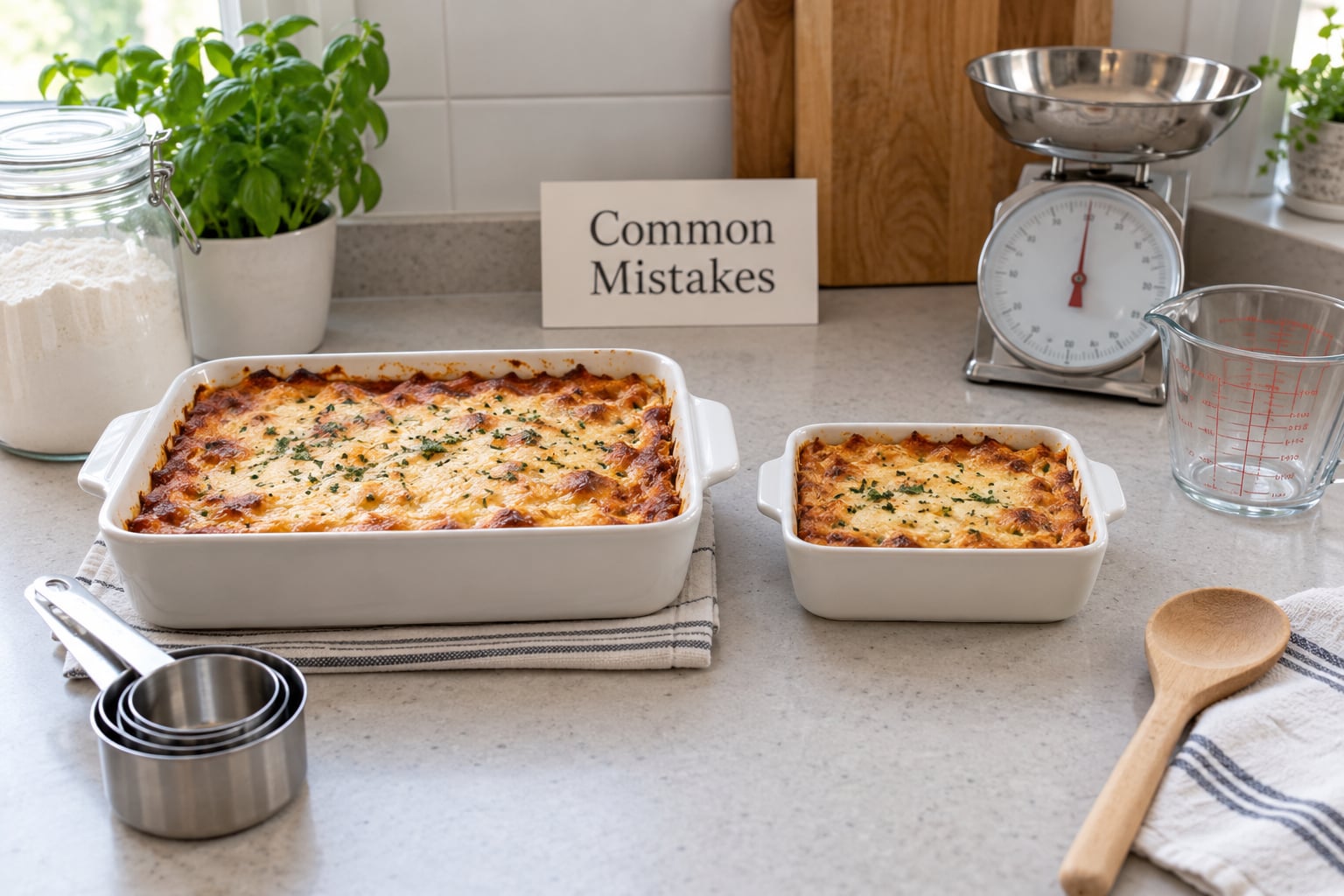
Using the same pan. The math was right, the depth was wrong. Half the batter in a full-size pan bakes thin, dries out at the edges and stays gummy in the middle. Pick a pan from the volume table.
Halving the bake time. A smaller cake does not take half as long, and it usually takes noticeably less. Keep the temperature, start checking at three-quarters of the original time.
Splitting the egg unevenly. One recipe I halve calls for three eggs. Scooping half a shell of yolk into the bowl gives you mostly yolk; measuring 1 1/2 tablespoons of beaten egg gives you the real proportion.
Under-cutting the leavening. Baking soda and baking powder halve exactly. Skipping them produces dough that spreads and a cake that sinks, and neither recovers in the oven.
Halving salt and then never tasting. Halving salt exactly is fine in baking. In a soup or a braise, season to taste at the end, because concentration changes when the liquid drops.
Measuring tiny amounts too precisely. Half of 1/8 teaspoon is 1/16 teaspoon. Guessing between 1/16 and 1/8 teaspoon is closer than you think, and obsessiveness there costs you time you could spend on the pan.
Scaling the prep, not just the recipe. If the original recipe tells you to dice two onions, half of that is one onion. If it tells you to preheat for 30 minutes, you still preheat the oven. Prep quantities are the easiest place to skip the math and end up with a double batch of mise en place.
When You Should Skip Halving Entirely
Some recipes resist halving, and forcing them costs you ingredients anyway. The pattern in the baking forums is consistent: people halve a three-egg cake, get a broken loaf, and wish they had just made the full thing.
Odd egg counts in structural baking. One egg left over is not a problem. One egg holding together a layer cake or a loaf cake is a problem, because structure depends on egg proteins setting in the right proportion to flour and fat. Make the full batch and freeze half, or find a recipe already written for the egg count you have.
Custards, meringues and anything relying on precise ratios. A halved custard cooks faster and sets differently, because starch-to-liquid ratio and evaporation both change with volume. The same goes for meringue, where a tiny change in egg white and sugar alters the result more than you would expect.
Very small yeast doughs. A few hundred grams of dough does not heat or rise the same way a large batch does, because the dough has less thermal mass and less gas retention. Small-batch bread and rolls tend to spread and bake unevenly.
What to do instead: make the full batch and freeze it. Portion cookies, brownies, muffins and dough into single servings, cool them completely, and freeze them on a tray before bagging. That way you get the small-portion outcome without the baking chemistry problems, and most of these freeze for a month or more.
Frequently Asked Questions
How do I divide an egg in half?
Crack the egg into a small bowl, beat it with a fork until the yolk and white are fully combined, then measure out half. A large egg yields about 3 tablespoons of beaten egg, so half is 1 1/2 tablespoons. By weight, one large egg is about 50 g without the shell, so half is 25 g. Always whisk first. Splitting an intact egg usually gives you mostly yolk, which changes the fat ratio and can leave a cake dense.
How do I halve a recipe that calls for 3 eggs?
You need 1 1/2 eggs. Beat the three eggs together in a bowl, measure out 1 1/2 tablespoons for the recipe, and refrigerate or discard the rest. Beating first is the key step, because yolk and white are otherwise measured unevenly. In cakes, loaves and other structural bakes, three eggs is also a signal to make the full batch and freeze half instead.
How do I split a cake recipe in half?
Halve every ingredient, halve the baking powder and soda exactly, and keep the egg count as close as you can by beating and measuring. Then change the pan, not the temperature. Find a pan whose volume is about half the original, since a smaller pan gives a shallower layer that bakes unevenly. Keep the oven temperature and start checking doneness at three-quarters of the original bake time.
What pan size do I use for half a recipe?
Match volume, not width. Multiply length by width by depth to get cubic inches, then find a pan near half that number. Half of a 9 x 13 pan is about 117 cubic inches, which matches a quarter sheet pan. Half of a 9-inch round is about 64 cubic inches, which matches an 8-inch loaf pan. Fill the smaller pan to roughly the same depth as the original, not to the rim.
Do you halve the cooking time when you halve a recipe?
No. Less food heats faster, so a halved batch usually needs less time, not the same time. Start checking at roughly three-quarters of the original cooking time and stop the moment the food is done. For baked goods use a toothpick test. For meat, use a thermometer: 165°F for poultry, 160°F for ground meat, and 145°F for whole cuts and fish.
Should I halve the spices and salt too?
Halve baking powder and baking soda exactly. For salt, pepper, chili, vinegar and extracts, start a little under half, around 40 percent of the original, then season to taste at the end. Concentrated flavors can read as too strong in a smaller volume because the fat and sugar that soften them also shrank. Fats, liquids, flour and sugar halve cleanly as written.
Start with the list, not the pan. Write out every halved amount, measure the leavening exactly, cut the seasoning slightly under half, and then pick a pan with about half the volume. Keep the temperature where the recipe put it, start checking doneness earlier, and taste before you serve. Ten minutes of that gives you a small batch that behaves like the original, and it keeps working for every recipe after this one.