The short answer is that if you want to know how to time a holiday dinner so everything is hot, you do not start with a recipe, you start with a clock. Pick the minute you want to sit down and eat, subtract every dish’s cook time, then subtract its resting and holding time, and whatever is left is when that dish goes in the oven. Done that way, everything arrives hot at the same moment instead of the main dish sitting on the counter for forty minutes while the last casserole finishes.
That method works for a turkey, a ham, a prime rib, a seafood spread or a vegan table, and it takes about twenty minutes of planning the night before. The tricky part is not the math, it is the holding, so I spend as much time below on which dishes survive a warm hold and which ones go soggy or dry.
Table of Contents
- What You Need
- How to Time a Holiday Dinner So Everything Is Hot: Step-by-Step Plan
- Step 1: Choose the serving time and map the menu
- Step 2: Build a backward timeline and assign cooking stations
- Step 3: Cook the longest items first and control temperature
- Step 4: Time vegetables, potatoes, sauces, and sides
- Step 5: Reheat, rest, garnish, and serve
- Common Mistakes
- Frequently Asked Questions
- What temperature should I keep holiday food warm at?
- How far ahead should I start cooking a holiday dinner?
- Can I cook the main dish the day before and reheat it?
- What should I make the night before a holiday dinner?
- What do I do when dinner is running late?
- Conclusion
What You Need
Before you start cooking anything, gather five things. Without them you are improvising, and improvised holiday meals are the ones where the potatoes arrive an hour before the guests sit down.
- A firm serving time. Write the clock time on paper. Four o’clock is a decision, not a hope.
- Your full menu, including drinks, appetizers and dessert, with the number of guests you are actually feeding.
- Real cook times from your own recipes, not the optimistic ones. Write down total time and hands-on time separately.
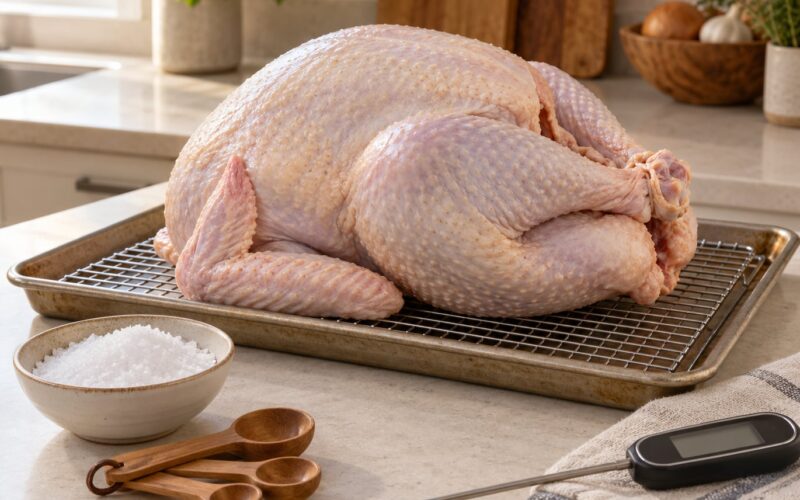
- Rest and hold times for each dish. A 20-pound turkey needs 30 to 40 minutes of rest before carving, and that time belongs in the schedule too.
- A written timeline and one kitchen timer you can see from the stove. A phone alarm per dish works just as well.
Also check what your equipment can actually hold. Most home ovens run two usable racks, and a countertop oven, a slow cooker or a microwave-convection unit is the difference between a calm kitchen and a queue at the oven door. Count your burners too, because four burners means two stove dishes, not five.
How to Time a Holiday Dinner So Everything Is Hot: Step-by-Step Plan
Step 1: Choose the serving time and map the menu
Set your serve time first, then work backwards. Most people choose their serving time around guests, not around the food, which is exactly why dinner lands twenty minutes late every year.
Two practical anchors. If kids or older relatives are coming, aim for the time you would normally eat, not twenty minutes earlier. If you are serving a buffet, give yourself an extra 20 minutes at the front because people will drift in and out during the first half hour.
Then write out every dish with three numbers: total cook time, hands-on time, and how long it can sit before service without ruining. That third column is the one people skip, and it is the one that decides the whole schedule.
Step 2: Build a backward timeline and assign cooking stations
Convert cook times into start times by subtracting from the serve time, starting with the dish that needs the longest total. Then subtract rest and hold time, because a bird that is carved the second it leaves the oven will be dry and will release juice all over the carving board.
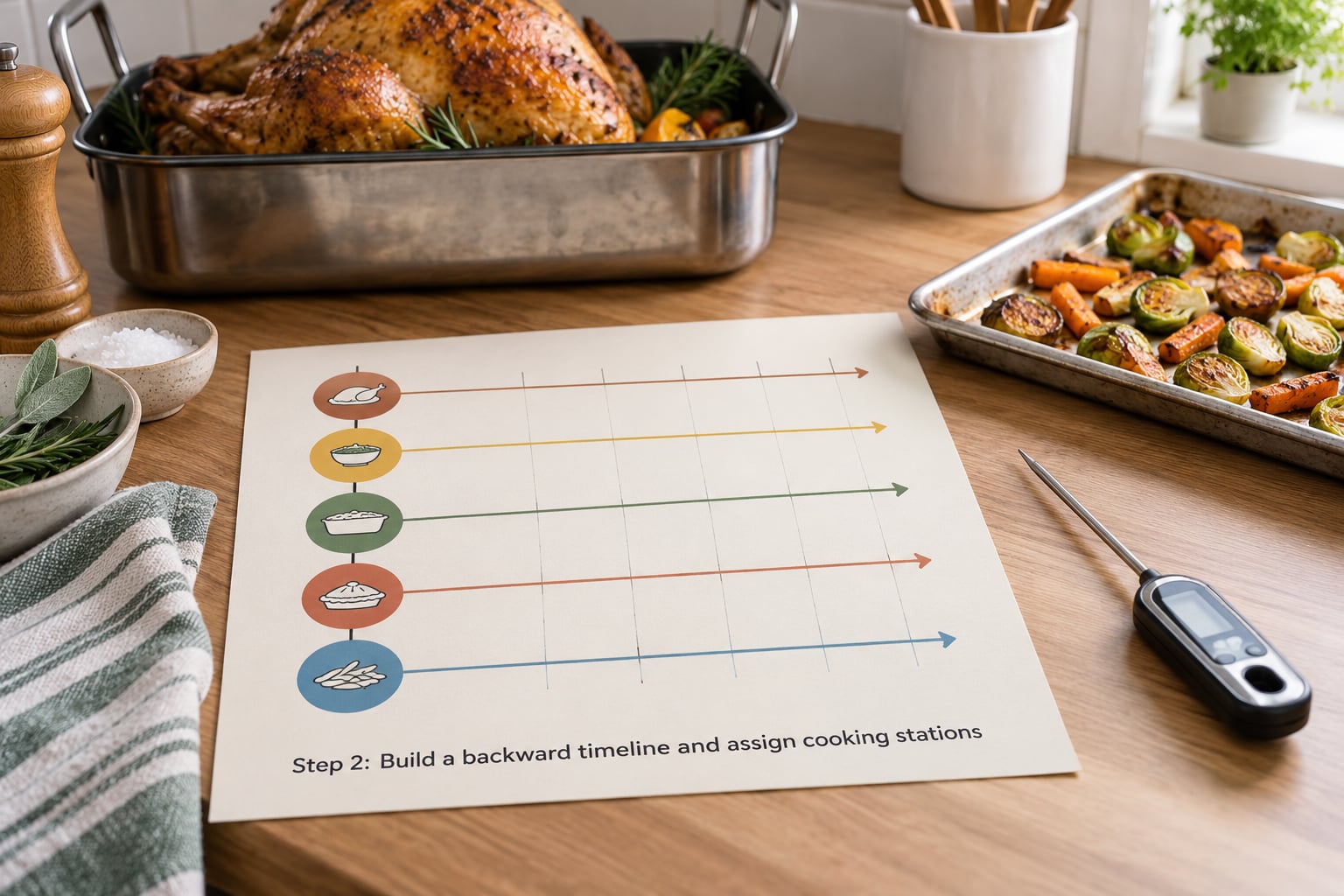
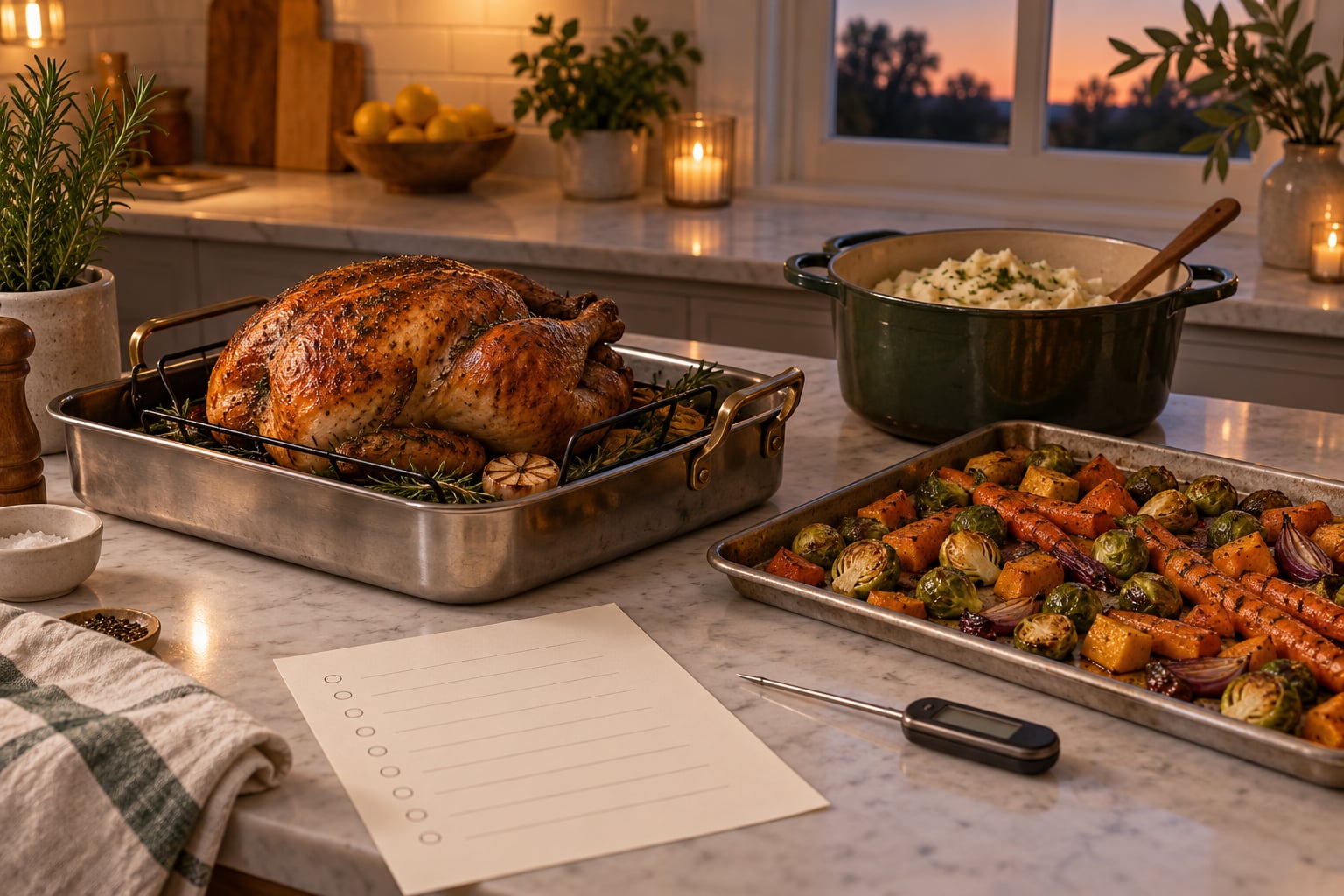
Here is the shape of a countdown schedule for a 4 p.m. dinner with a roasted main, potatoes, a green vegetable, a make-ahead casserole and gravy. Fill in your own times on the right-hand column and the schedule works for any menu.
| Time before serving | Task | Example clock time |
|---|---|---|
| T minus 6 hours | Roast starts, or slow cooker goes on low | 10:00 a.m. |
| T minus 3 hours | Scrub potatoes, start them, set the table | 1:00 p.m. |
| T minus 2 hours | Make-ahead casserole into a low oven or slow cooker on warm | 2:00 p.m. |
| T minus 1 hour | Gravy from drippings, vegetables blanched or trimmed | 3:00 p.m. |
| T minus 30 minutes | Warm plates, drop potatoes, roast goes into the warming oven covered | 3:30 p.m. |
| T minus 15 minutes | Finish vegetables, rest the main, plate the cold sides | 3:45 p.m. |
| T minus 5 minutes | Carve, spoon gravy, carry everything out together | 3:55 p.m. |
Now assign each dish to a station: oven upper rack, oven lower rack, stovetop, slow cooker, countertop oven or fridge for make-aheads. Dishes that must hold go in first, because they are the ones going to wait for everybody else. Fast sides go in last.
Build in a 20-minute buffer somewhere. A stuck pan, a guest arriving early or a thermometer reading lower than you expected is normal, and the buffer is what stops those small delays from cascading.
Step 3: Cook the longest items first and control temperature
The long item goes in first, at the temperature it wants, and you do not let the oven get talked out of it. Roast the main at its proper temperature, then move it to a lower setting to rest, rather than cooking it at a lower temperature to save a step.
For temperature math, budget roughly 13 minutes per pound for an unstuffed roast bird at 325F, 20 minutes per pound for a stuffed one, and add 30 to 40 minutes of rest. Pull poultry when an instant-read thermometer hits 165F in the thickest part of the breast and the innermost thigh. Ground meat needs 160F and whole cuts or fish need 145F, and carryover cooking will add a few more degrees while the dish rests.
Expect your oven to take 15 to 20 minutes to preheat properly and to need another 10 minutes to recover temperature when you open the door or slide a cold pan in. If you are roasting and then holding, that recovery time is the reason a dish can sit 20 minutes in a cold oven while your oven is still catching up.
Do not let the main sit on the stovetop while the rest of the meal finishes. Once it is done, move it to the lowest oven setting you have, usually 200F to 225F, in a covered roasting pan, or rest it on a warm platter if you are carving within 30 minutes. Loosely covered is the phrase to remember: tightly covered potatoes turn to mush, but a roast left uncovered in a warm oven dries out over an hour.
Step 4: Time vegetables, potatoes, sauces, and sides
Potatoes and sauces are the anchors of the meal, so treat them like the main rather than like afterthoughts. Start boiling or roasting potatoes about 45 minutes before you want them on the table, and keep them warm in the same pot with the lid on and a folded towel over it.
Vegetables split into two groups. Quick green beans or a sautéed spinach take five to eight minutes in a hot pan right at the end, so they land crisp instead of grey. Roasted root vegetables want 30 to 40 minutes at 425F, which means they go on an upper rack while the main is resting, not at the same time as the main.
Make-ahead casseroles and gratins are the easiest things to time because they reheat well. Put them in the oven at 200F to 250F for 20 to 30 minutes, or into a slow cooker on warm, then stir or top with fresh breadcrumbs in the last five minutes so they do not go dry or soggy while they wait.
Do the flavor work before service, not during it. Make your gravy ahead from drippings and stock, keep it in the fridge, and finish it on the stove in the last 20 minutes so it is hot and shiny when the main comes out of the resting oven. Nothing makes a meal look rushed like a cold gravy sitting next to a hot bird.
Step 5: Reheat, rest, garnish, and serve
The last thirty minutes are where good timing is won or lost. Warm your plates in a sink of hot water, or run a quick dishwasher cycle if the oven is full, because food served on a cold plate feels lukewarm even when it is hot in the middle.
Rest your main uncovered for 20 to 30 minutes, covered for up to 40. During the final five minutes, carve, spoon the gravy, add the garnish that was missing and carry everything to the table in the same trip where you can. Hosts on cooking forums describe the same fallback day after day: one potluck dish, no big oven, and the practical answer is to set it out when you sit down and let people serve themselves.
Not everything tolerates a long warm hold. Here is the honest version of which dishes can wait and which cannot.
| Dish | Holds well? | Best holding method | Comfortable hold |
|---|---|---|---|
| Roast, ham, prime rib | Yes, if covered | Warming oven at 200F to 225F, foil tent | About 1 hour |
| Mashed potatoes | Very well | Same pot, lid on, low heat, a little butter on top | 2 hours |
| Sausage stuffing | Well | Covered casserole dish in the warming oven | About 1 hour |
| Green bean or corn casserole | Well | Slow cooker on warm, or low oven covered | 3 to 4 hours |
| Roasted vegetables | Fairly well | Sheet pan in the warming oven, loosely covered | 45 minutes |
| Fresh green vegetables | Poorly | Cook them last, straight off the heat | 15 minutes |
| Gratin or cheesy bake | Goes soggy | Reheat in the last 25 minutes, keep uncovered | 25 minutes |
| Rolls or bread | Dries out | Low oven, tented with a damp towel | 1 hour |
Common Mistakes
Starting everything at once. The classic failure. The fix is to sort the menu into three buckets: long and holdable, medium, and last-minute. Only the long bucket starts first.
Overcrowding the oven. Two racks, four pans, and every dish needing 350F means you are cooking four things in the space of two and nothing gets proper heat. The fix is moving one dish to a slow cooker, a countertop oven or the stovetop before you add a third pan, and leaving air around each one.
Forgetting rest and hold time. This is the mistake that makes food cold, not late. Subtract 30 minutes of rest for a roast and 20 minutes of warm hold for anything you finish early, then look at your start times again.
Using one timer for the whole meal. Set a separate alarm for every start and every finish. Cooks on forums overwhelmingly say the handwritten countdown taped to the wall plus a phone alarm per dish is the system that actually survives contact with a real holiday.
Serving dishes too early. If the first thing to leave the kitchen is the main, the table waits on it and everything else cools. Send the make-aheads out first, plate cold sides, and bring the hot food in last.
Leaving food in the danger zone while you panic. Perishable food should sit at 140F or above, and it should not sit at room temperature for more than two hours. If you need to reheat a dish, take it to 165F before serving.
Cooking at someone else’s house with no plan. Ask what appliance space exists, cook the dish that travels worst last, and transport it in a covered carrier or insulated bag with a towel wrapped around the hot dish. If you are driving more than 20 minutes, a slow cooker on warm is safer than a foil-covered tray.
One more habit pays off more than any gadget: assign somebody the drinks and the appetizers so that during the final 45 minutes nobody is standing in the kitchen asking when dinner is.
Frequently Asked Questions
What temperature should I keep holiday food warm at?
Keep hot food at 140F or above. In a home kitchen, the practical way to hit that is your oven set to its lowest setting, usually 200F to 225F, with a dish loosely covered in foil. Hot water in a sink works for plates, and a slow cooker on its warm setting is a reliable overflow spot. Aim to hold anything for under an hour, and reheat finished dishes to 165F before serving.
How far ahead should I start cooking a holiday dinner?
Count back from your serve time and treat the longest dish as the anchor. A 20-pound unstuffed turkey at 325F needs roughly 13 minutes per pound, or about 4 hours 20 minutes, plus 30 to 40 minutes of rest. On the 4 p.m. schedule above, that bird goes in at 10:00 a.m., comes out at 2:20 p.m., rests until about 3:20 p.m., and holds in the warming oven for the last 40 minutes. Add a 20-minute buffer, because ovens take time to preheat and recover.
Can I cook the main dish the day before and reheat it?
You can, but texture suffers. Turkey and ham reheat noticeably drier than they cook, and breast meat suffers most. If you do it, cook to 165F, chill the food within two hours, cover it, and reheat covered with a splash of stock in the pan at 325F until it reaches 165F, usually 2 to 3 hours for a whole bird. Roasts, casseroles, stuffing and mashed potatoes all reheat far more gracefully.
What should I make the night before a holiday dinner?
Make the dishes that reheat well and improve overnight: casseroles and gratins, stocks and gravy bases, stuffing, pie dough, croutons, and chopped vegetables for soups. Cook grains, casseroles and sauces a day ahead and refrigerate them covered, then reheat to 165F on the day. Hold off on anything crisp, anything dressed, and anything that depends on being freshly cooked until the day itself.
What do I do when dinner is running late?
Resequence instead of rushing. Bring out whatever is ready, start serving, and put the late dish out when it lands rather than holding the whole table hostage. Reheat make-aheads at high heat so they reheat fast, skip the last garnish on any dish that is waiting, and lower the heat on anything sitting in the warming oven so it dries out less. A dinner served 20 minutes late still beats a table waiting on a garnish.
Conclusion
To time a holiday dinner so everything is hot, you do one thing tonight: pick the minute you want to sit down, write it at the top of a page, and work backwards one dish at a time, subtracting cook time, then rest time, then holding time. The schedule you get is the recipe plan for the day itself, and once you have run it once with a written countdown and a thermometer, the year after that takes twenty minutes of planning instead of the whole afternoon.