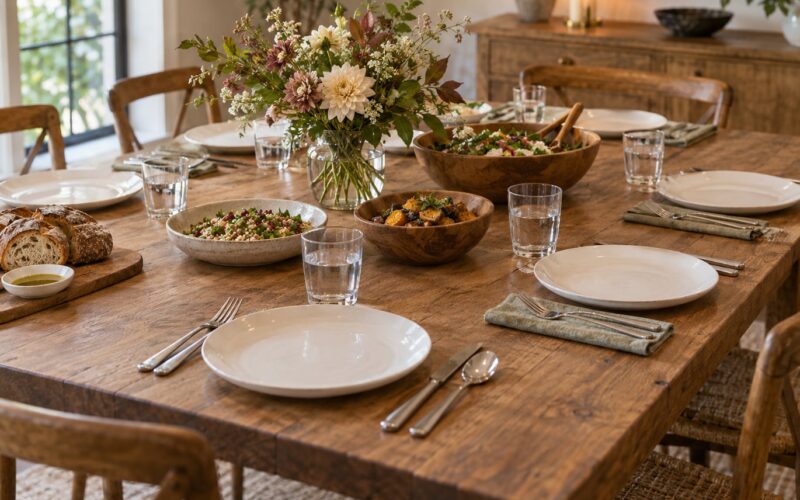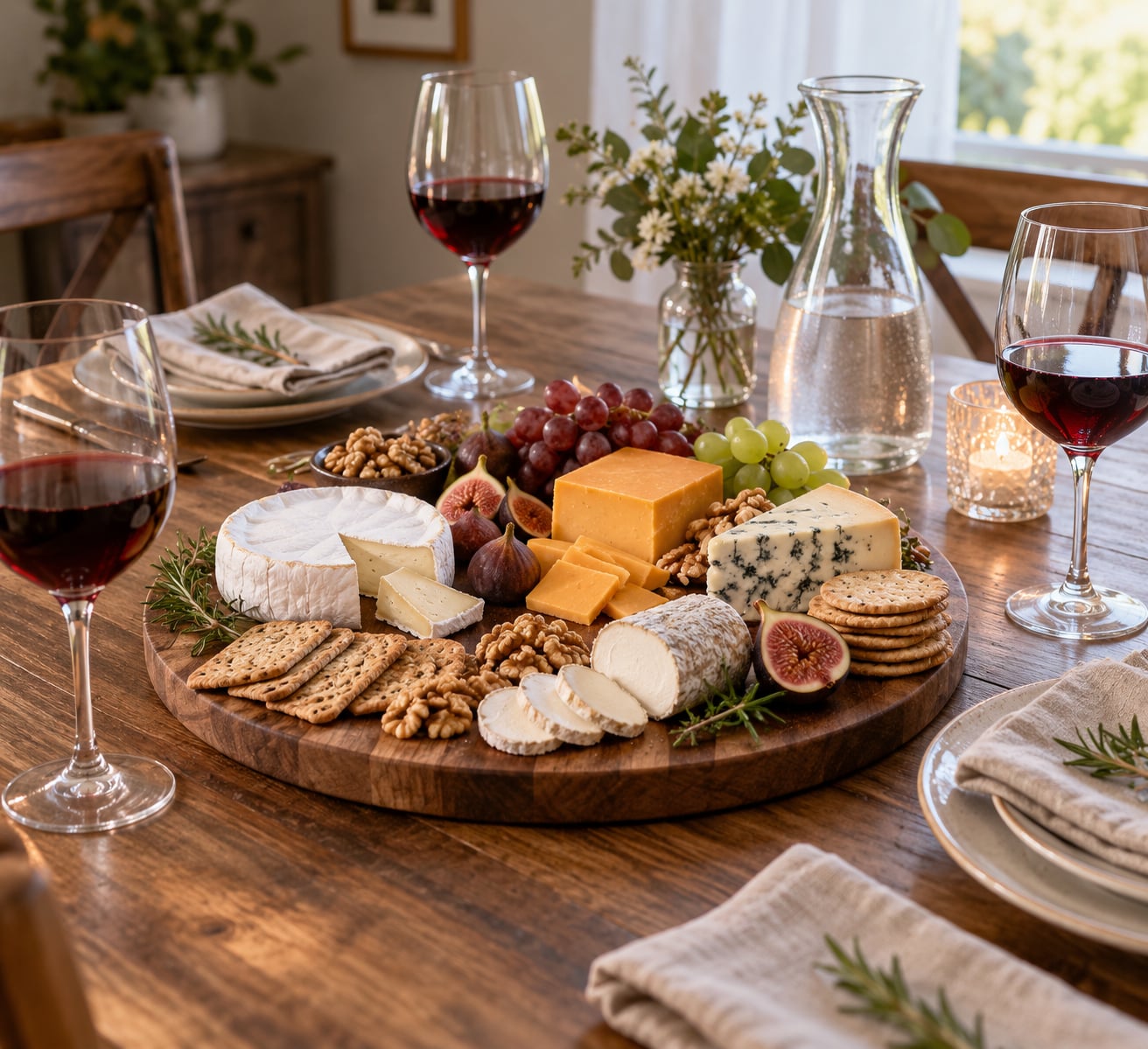
A wine and cheese night at home works when you plan three things and then stop thinking about it: how much to buy, which wine goes with which cheese, and the order guests eat them in. Set the guest count, choose one red, one white and three to five cheeses, and put the cheese out at room temperature about two hours before anyone arrives. Everything else is napkins, water and a board with some space on it.
This is a no-cook evening, which is why it works so well for a Friday with friends, a date night for two, or a book club that does not want to sit through dinner. It takes about 20 minutes of planning, roughly two hours of actual eating, and 10 minutes to reset the table afterward. I’ve run this format more than a dozen times and the same three problems cause every bad night: too much food, wine that has been sitting warm on the counter, and a board so crowded that nobody can tell one cheese from another.
Table of Contents
- What You Need
- Cheese: three to five kinds, from three different families
- Wine: one red, one white, one sweet finish
- Tools and the rest
- Optional extras worth buying
- Storage before the night
- How to Host a Wine and Cheese Night at Home, Step by Step
- Set the format and guest count
- Choose wines and cheeses that work together
- Build a balanced cheese board
- Map the pairings and serving order
- Set up the tasting area
- Close the night and store leftovers safely
- Common Mistakes
- Frequently Asked Questions
- How much wine and cheese do I need per person for a wine and cheese night?
- What are the best beginner wine and cheese pairings?
- How many cheeses should I serve for 4, 6, or 8 guests?
- Should a wine and cheese board be served before guests arrive or as a course?
- How long can opened cheese sit out during a wine and cheese night?
- What food and drinks should I add besides wine and cheese?
- Conclusion
What You Need
Start with the number of people, because everything else scales from it. Then buy for two to three ounces of cheese per guest across the whole board, not per cheese, and plan on five-ounce wine glasses for guests who drink and two to three glasses over the evening.
| Guests | Total cheese | Cheeses on the board | 750 ml bottles | Crackers and crostini |
|---|---|---|---|---|
| 2 | 8 to 10 oz | 4 | 1 to 2 | 1 small box |
| 4 | 14 to 16 oz | 5 | 3 | 2 boxes |
| 6 | 20 to 24 oz | 6 | 4 | 3 boxes |
| 10 | 32 to 36 oz | 7 | 6 | 5 boxes |
The bottle number assumes about half your guests drinking regularly. If the whole group drinks, add a bottle for every four people, and expect to open the last one later than you planned.
Cheese: three to five kinds, from three different families
The rule most beginners need is simple: three cheeses is plenty for four guests, and six is the ceiling for ten. Space them out. Buy one from each of these groups rather than four soft rounds that taste the same:
- Soft-ripened with a bloomy rind: Brie, Camembert. Mild, creamy, faintly mushroomy.
- Washed rind: Taleggio, Limburger, Époisses. Pungent and savory, and the most divisive cheese on any board.
- Firm goat: Chèvre, a plain goat log. Tangy and light.
- Hard aged: aged cheddar, Parmesan, Manchego. Firm, nutty, keeps well.
- Blue: Stilton, Gorgonzola, Roquefort. Salty and sharp, and it anchors the end of the tasting.
Wine: one red, one white, one sweet finish
Two bottles cover four guests comfortably. Three is the sweet spot for six or eight: a crisp white, a medium-bodied red, and something sweet or sparkling for the blue cheese. Buy from a wine shop when you can, and ask the person behind the counter which bottle from their shelf they would pair with a goat cheese. That question gets a better answer than most guides give.
Tools and the rest
- A board or platter with room, plus a second small platter if you are doing a main cheese and a blue.
- A separate small knife or cheese plane for each cheese. Shared knives smear flavors across the board.
- Paper or slate labels naming each cheese, or a numbered card if you are doing a blind tasting.
- One small plate and two or three napkins per person. Cheese eaten over a couch cushion is a stain.
- Acarafe or bucket of cold water. It doubles as a palate cleanser and a spit bucket, which saves guests who would rather not finish a glass.
- An ice bucket if you are serving whites, and a corkscrew that works.
Optional extras worth buying
Bread, olives and pickles are not required. What genuinely helps is one acidic thing (cornichons, pickled onions), one sweet thing (figs, honeycomb, dried apricots) and one nutty thing (walnuts, almonds). Those three do the work that a dozen olives would attempt.
Storage before the night
Keep everything refrigerated until about two hours before guests arrive. Soft and washed-rind cheeses lose their texture when served cold from the fridge, so temper them on the counter. Perishable food should not sit at room temperature for more than two hours, or one hour if the room is above 90°F, so for a long evening take the perishable items away rather than leaving the whole board out all night.
How to Host a Wine and Cheese Night at Home, Step by Step
Set the format and guest count
Decide what kind of night this is before you shop, because the format changes the shopping list. A casual tasting lets people graze for two hours and needs the most food. A seated cheese course needs less and moves faster. A guided tasting, where you pour and talk through each pairing, needs the fewest cheeses and the most attention from you.
My default for six is a guided tasting with six cheeses, because it gives everyone a clear place to start. If your group is larger than eight, switch to casual grazing and double the crackers, since the food disappears faster when nobody is waiting on the host.
Write the guest count somewhere you will see it while shopping, then add one extra portion. Cheese and wine leftovers are useful the next day; a board with nothing on it is a wasted evening.
Choose wines and cheeses that work together
Buy a small range of styles rather than one of everything. The pairing logic is simpler than most guides make it sound: match intensity to intensity, and let acidity do the heavy lifting.
| Cheese | Wine style that works | Why it works |
|---|---|---|
| Goat cheese, feta, fresh mozzarella | Sauvignon Blanc, dry sparkling wine | High acid cuts through the fat |
| Brie, Camembert, ricotta | Chardonnay, Pinot Grigio | Light oak mirrors the buttery texture |
| Manchego, young cheddar | Rioja, Pinot Noir | Soft tannin handles the salt and nuttiness |
| Aged cheddar, Parmesan | Malbec, Merlot, Cabernet Sauvignon | Full-bodied reds stand up to hard cheese |
| Blue, Stilton, Gorgonzola | Tawny port, sweet Riesling | Sweetness softens the salt and mold |
| Washed rind, Taleggio | Dry rosé, light red | Freshness resets after the funk |
| Aged Gouda, Gruyère | Sparkling wine, Alsace Riesling | Carbonation and sweetness cut the density |
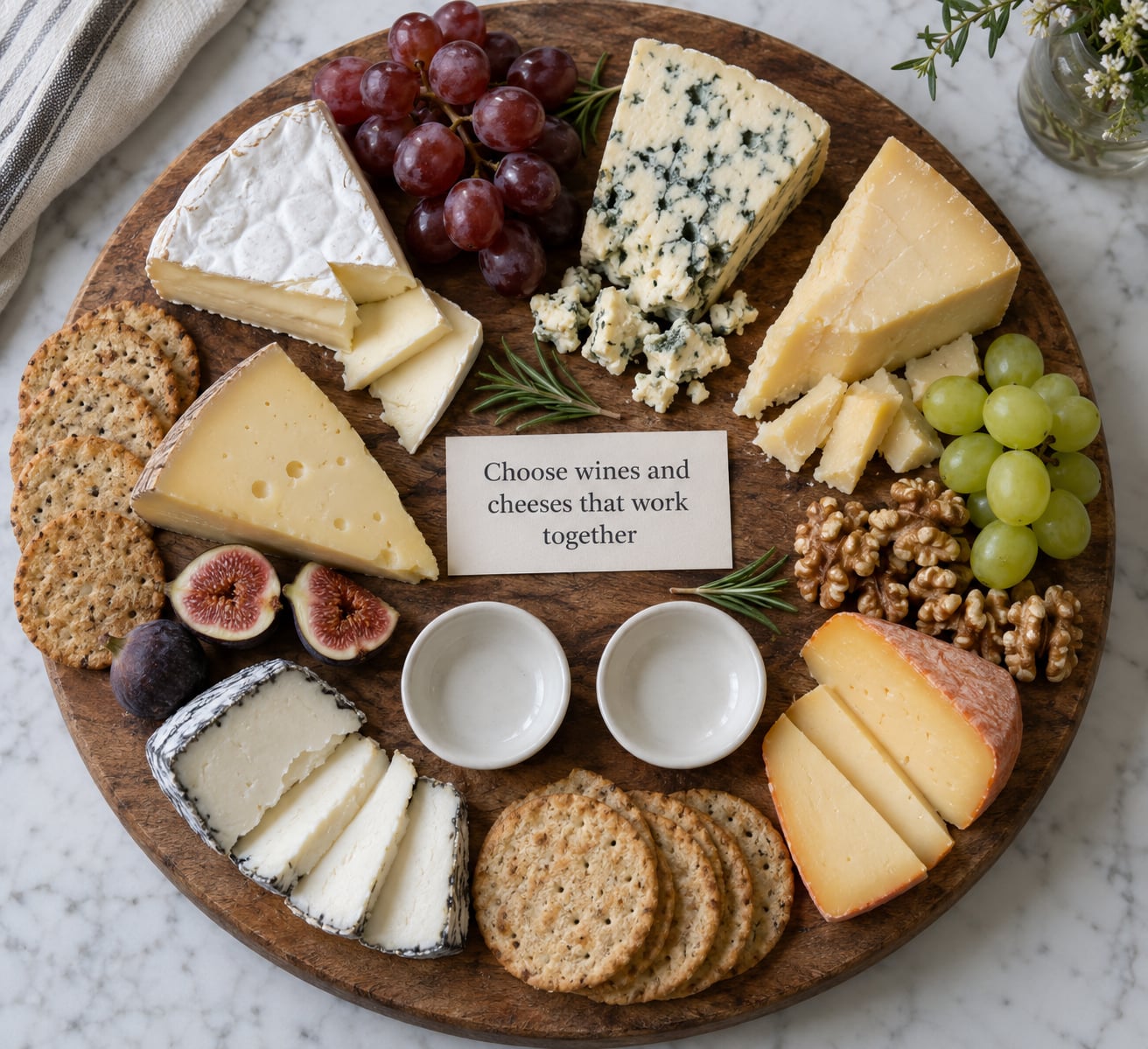
For a beginner wine and cheese night, three pairings are plenty: a goat cheese with a crisp white, a Brie with a light-bodied red, and a blue with a sweet wine. Those three cover delicate, medium and strong flavors, and every guest finds something they like.
Build a balanced cheese board
Cheese should be most of the surface area. On a standard board, keep accompaniments to roughly a quarter of the space and leave gaps so flavors do not mingle, which is the single most common board mistake. One host on a home forum thread described boards that were three-quarters olives and grapes, which looks generous and tastes like nothing.
Arrange cheeses in distinct groups rather than a ring, and put the strongest one at the far end. Give each its own knife, and label each with its name written legibly. If you are skipping labels, put the cheeses in the order you plan to serve them so the route is obvious.
Leave two or three empty tasting spots on the board. Guests use those to combine a bite of cheese with a bite of fruit or cracker, and an empty corner does that job without anyone touching the main piles.
Map the pairings and serving order
Tell guests the route at the start, in one sentence: start at the left, move right, and taste the blue last. Then serve each pairing together rather than putting out everything at once and letting people improvise.
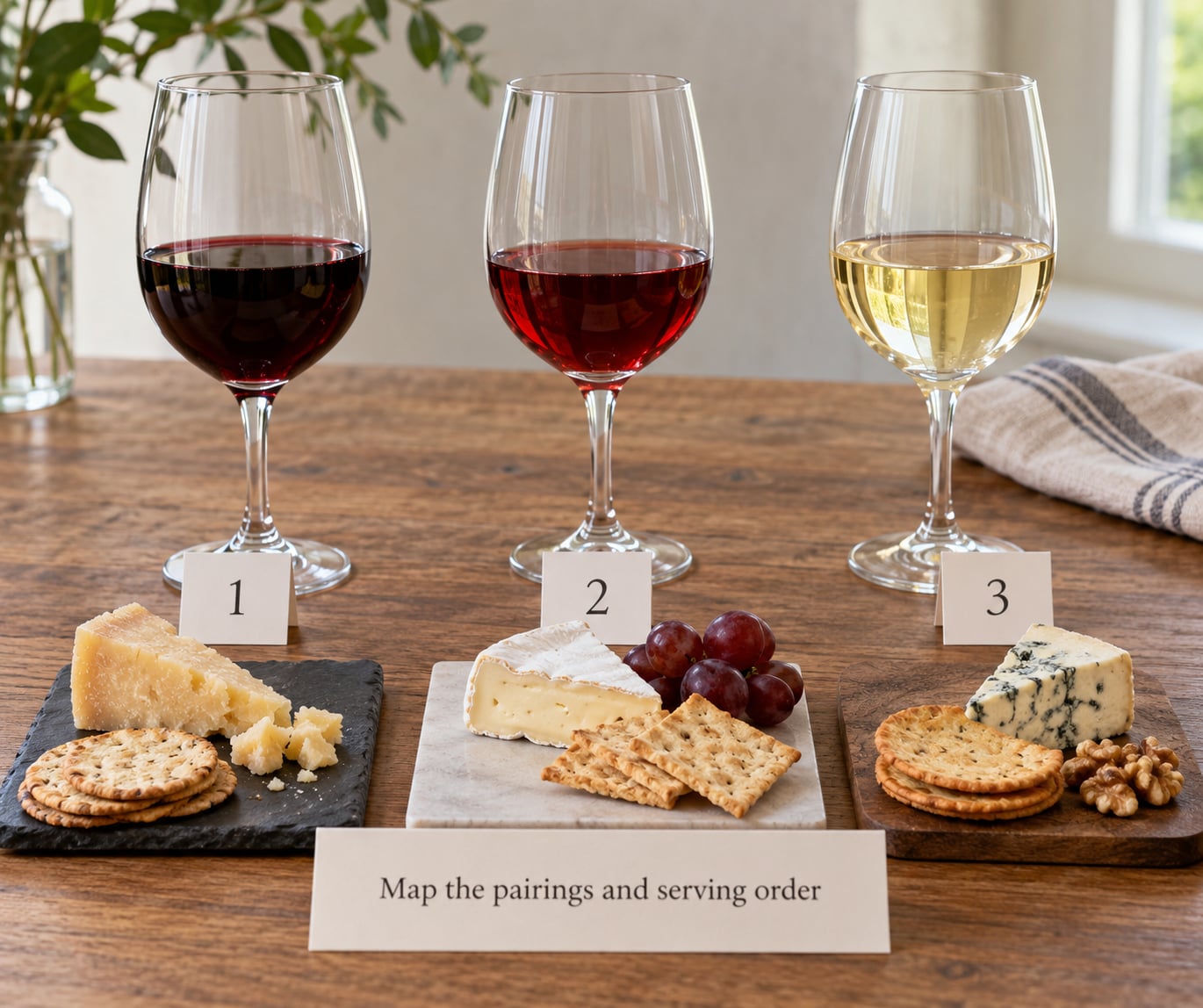
You can pair one wine to two cheeses, but do not stretch one bottle across an entire evening. Two cheeses per wine means guests get to compare, which is the part people remember.
Set up the tasting area
Temperature does more work than any pairing decision. Get it roughly right and even mediocre pairings work.
| Wine | Serve at | Notes |
|---|---|---|
| Sparkling | 38 to 45°F | Too cold and the bubbles go flat and sharp |
| Light white, rosé | 49 to 55°F | Ice bucket with a mix of ice and water |
| Full-bodied red | 58 to 65°F | Slightly cool, not warm; chill reds stay refrigerator-cold |
| Light red, older red | 60 to 65°F | Sit 20 to 30 minutes before pouring |
| Sweet or fortified | 55 to 60°F | Pour small; these go far |
Beyond temperature, the setup is small decisions. Pour the wine yourself so glasses do not get mixed up, and mark glass stems with a small dot of nail polish or a rubber band if people will be setting glasses down all evening. Seat the water carafe within reach. Keep scented candles, cleaning products and fried food away from the board, because odor sticks to soft cheese and nobody wants a lavender brie.
Music should be low enough that nobody raises their voice to be heard. Nobody should have to walk past the board repeatedly either; traffic kills the arrangement you spent ten minutes on.
Close the night and store leftovers safely
Wind down around the two-hour mark. Offer coffee or tea, which gives people a reason to stay without more cheese, and let the last bottle open naturally rather than pouring it at the end.
For leftovers, wrap each cheese separately in wax paper or a sealed bag so the washed rind does not take over everything else in the fridge. Hard cheeses keep for a few weeks; soft cheeses about a week. Discard anything that smells ammonia-heavy, has visible mold beyond a bloomy rind’s usual surface, or has sat out past the two-hour mark. Crackers go stale within a few days and are better left out. Wine recorks and keeps a few days; fortified wines keep weeks.
Cleanup takes one pass: bag the board scraps, wipe down knives and the counter, and wash the water carafe. Because there is no cooking, the whole teardown is under ten minutes.
Common Mistakes
Overbuying. Buy for the guest count plus one, and resist the fourth wine. Extra food at today’s grocery prices is how a casual night turns into an expensive one. Fix: if you are unsure, plan four cheeses for four people and add a fifth only if the group is enthusiastic.
Too many cheeses. Eight varieties on a home board is eight knives and eight flavors nobody can track. Fix: cap it at five for a casual group, six for eight or more guests.
Pairing by color instead of flavor. A white cheese does not automatically want a white wine. Fix: match intensity, and remember that mild cheeses handle full-bodied reds better than most people expect.
Crowding the board. If every cracker is touching a cheese, flavors mingle and the display turns to paste. Fix: keep accompaniments to about a quarter of the surface and leave real gaps.
Skipping water. Without it, guests drink through their palate and everything tastes flat after the second pairing. Fix: one carafe within reach, plus a small empty pitcher as a discreet dump bucket.
Forgetting glassware. Mixing up glasses mid-tasting makes a good pairing taste like a mistake. Fix: pour for people, or mark stems with a dot of polish.
Leaving food out too long. Soft cheese left in a warm room past two hours should be tossed. Fix: set out the board 30 to 45 minutes before arrival rather than at the start of the night, and keep perishables chilled.
A few habits that make hosting easier: taste each cheese yourself before the night so you know what it should taste like, keep a bottle opener and a corkscrew within reach, and slice firm cheeses thinner than feels right. Nobody needs a formal course; the whole point is that it is relaxed.
Frequently Asked Questions
How much wine and cheese do I need per person for a wine and cheese night?
Plan two to three ounces of cheese per guest in total, not per cheese, and about five ounces of wine per drinker for a two-hour evening. That works out to roughly one 750 ml bottle for every two wine-drinking guests, plus one spare. For four people, buy 14 ounces of cheese, five cheeses and three bottles. For six, buy 20 ounces, six cheeses and four bottles.
What are the best beginner wine and cheese pairings?
Start with three: goat cheese with a crisp Sauvignon Blanc, Brie with a light-bodied red such as Pinot Noir, and a blue cheese with a sweet wine like tawny port or Riesling. That combination covers light, creamy and strong flavors, so every guest finds something they like. Add a fourth pairing only once you have run those three without trouble.
How many cheeses should I serve for 4, 6, or 8 guests?
Four cheeses for four guests, five for six, and six for eight. More than that needs a separate knife per cheese and becomes hard to taste, because flavors crowd each other and nobody can keep the order straight. Choose cheeses from different families so the board runs from mild to strong, and label each one.
Should a wine and cheese board be served before guests arrive or as a course?
Set the board out 30 to 45 minutes before guests arrive so the cheese reaches room temperature, then serve it as the first course with the first pour of wine. Serving it right after guests arrive means cold cheese and rushed pairing. For a longer evening, hold the perishable items in the kitchen and bring out a second round later.
How long can opened cheese sit out during a wine and cheese night?
Perishable cheese can sit at room temperature for up to two hours, or one hour if the room is above 90°F. After that, discard soft and washed-rind cheeses rather than refrigerating them again. Hard cheeses such as aged cheddar and Parmesan are lower risk and can be refrigerated and used later if they smell normal.
What food and drinks should I add besides wine and cheese?
Add one acidic item such as cornichons or pickled onions, one sweet item such as figs or honeycomb, and one nutty item such as walnuts. Bread and crackers make up the rest, with total accompaniments kept to about a quarter of the board. For guests who do not drink wine, serve sparkling water, grape juice or a non-alcoholic sparkling drink in a marked glass.
Conclusion
To host a wine and cheese night at home, decide the guest count and the format first, then shop for one red, one white, one sweet or sparkling bottle and three to five cheeses from different families. Take the cheese out two hours ahead, serve from mildest to strongest, and keep water within reach. Add extras only once the basics are working, because a small board that people can taste properly beats a large one they pick at for an hour.