To measure flour correctly for baking, weigh it on a digital kitchen scale: one level cup of all-purpose flour is about 120 grams, and mass does not change when you pack or shake the flour. Without a scale, fluff the flour with a spoon, spoon it into a dry measuring cup, mound it, and level off the top with a straight edge.
That last part is where most home bakes go sideways. Flour is a loose powder that settles and compacts, so scooping it straight from the bag can drop as much as three-quarters of a cup more flour into the bowl than the recipe asked for. Cookies come out cakey and thick, cakes turn heavy, and pastry dough cracks instead of rolling.
Flour is also one of the few ingredients where volume is genuinely unreliable. A cup of water is a cup of water. A cup of flour is whatever the flour decided to weigh that morning. This guide covers the two methods that work, the numbers behind them, and what to do when you have already gone wrong.
Table of Contents
- What You Need
- Measuring Methods Compared: What Each One Costs You in Grams
- Step-by-Step
- How to Weigh Flour for the Most Accurate Results
- How to Measure Flour Correctly with Cups or Spoons
- How to Handle Different Types of Flour
- Common Mistakes
- Tips for Consistent Baking Results
- Frequently Asked Questions
- Is 1 cup of flour the same as 1 cup of water?
- Do you measure flour before or after sifting?
- How do I measure 1 cup of flour accurately without a scale?
- Which measuring tool is best for weighing flour accurately?
- How do I measure flour without scales or cups?
- Why do my cookies turn out cakey and puffy?
- Conclusion
What You Need
You need very little, which is nice.
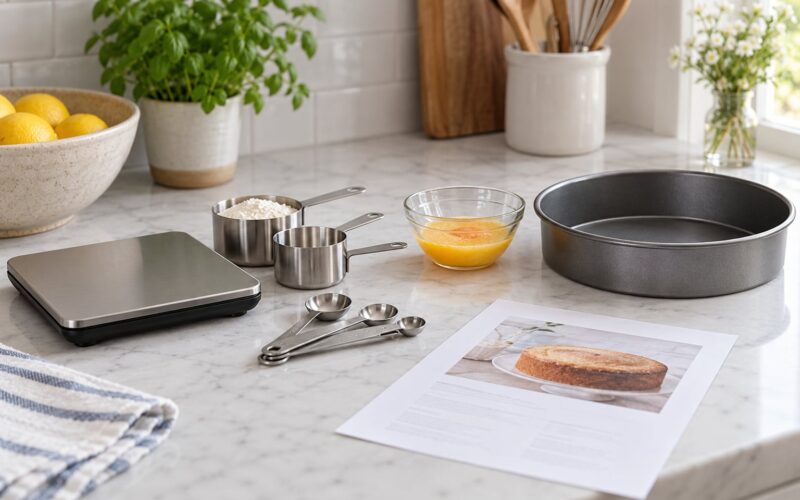
- A digital kitchen scale that reads in grams and has a tare or zero button. This is the single tool that changes your results.
- A mixing bowl that fits on the scale platform, or a flat plate if your scale is small. If the bowl overhangs the platform, the reading is wrong and you will never know by how much.
- One dry measuring cup, ideally 1-cup size with a level rim and a handle.
- A large spoon and a straight edge such as a knife back, offset spatula, or bench scraper for leveling.
- The flour the recipe names. Bread flour, cake flour, whole wheat, and self-rising are not interchangeable cup for cup, and the difference is large enough to matter.
Skip the liquid measuring cup for flour. The 1-cup line on a glass pitcher sits near the bottom of a wide bowl, and a “cup” read there is roughly a quarter less than a real cup. It is fine for milk. It is wrong for flour, and it is the single most common measuring mistake I see in recipes adapted from older cookbooks.
A flour sifter or sieve is optional. It matters for cake recipes that call for sifted flour, where the aeration is part of the recipe, but it does not change how much flour goes in unless the recipe tells you to weigh after sifting.
Measuring Methods Compared: What Each One Costs You in Grams
These are the weights five methods produce for what should be 120 grams of all-purpose flour, measured by weighing the filled cup on a scale.
| Method | Grams per cup | Overage vs 120 g | Verdict |
|---|---|---|---|
| Weigh on a scale | 120 g | 0 g | The only exact method |
| Fluff, spoon, level | 134 g | +14 g | Best no-scale method |
| Spoon, then level | 146 g | +26 g | Workable, still heavy |
| Scoop, then level | 155 g | +35 g | Avoid |
| Scoop and shake from the bag | 173 g | +53 g | The worst option |
The gap between the top and bottom rows is 53 grams of flour. In a cookie recipe calling for two cups, that is over a quarter cup of extra flour, and it is why the same recipe bakes differently in two different kitchens.
Step-by-Step
Pick one method and use it for the whole recipe. Mixing methods mid-recipe is how small errors become large ones.
How to Weigh Flour for the Most Accurate Results
Four steps, and the tare step is the one people skip. Weighing flour into a bowl that already registers 80 grams gives you 200 grams of bowl and flour, not 200 grams of flour.
- Place your mixing bowl on the scale, centered on the platform.
- Press the tare or zero button so the display reads 0 g. This subtracts the bowl’s weight so you only measure flour.
- Add flour gradually with a spoon, watching the number climb.
- Stop at the gram weight the recipe gives. Do not round, do not add a little extra for good measure.
If the scale has an ounce mode, use grams anyway. Ounces round to fractions that do not divide cleanly into most recipes, and switching units is how people end up 8 grams off. If your scale only reads ounces, weigh out the amount you need in grams once, note the ounce figure, and use that number consistently for that flour from then on.
Keep the bowl on the platform the whole time. Flour landing on the scale surround or your finger brushing the bowl changes the reading, and a scale sitting near a window or a running oven can drift slightly.
How to Measure Flour Correctly with Cups or Spoons
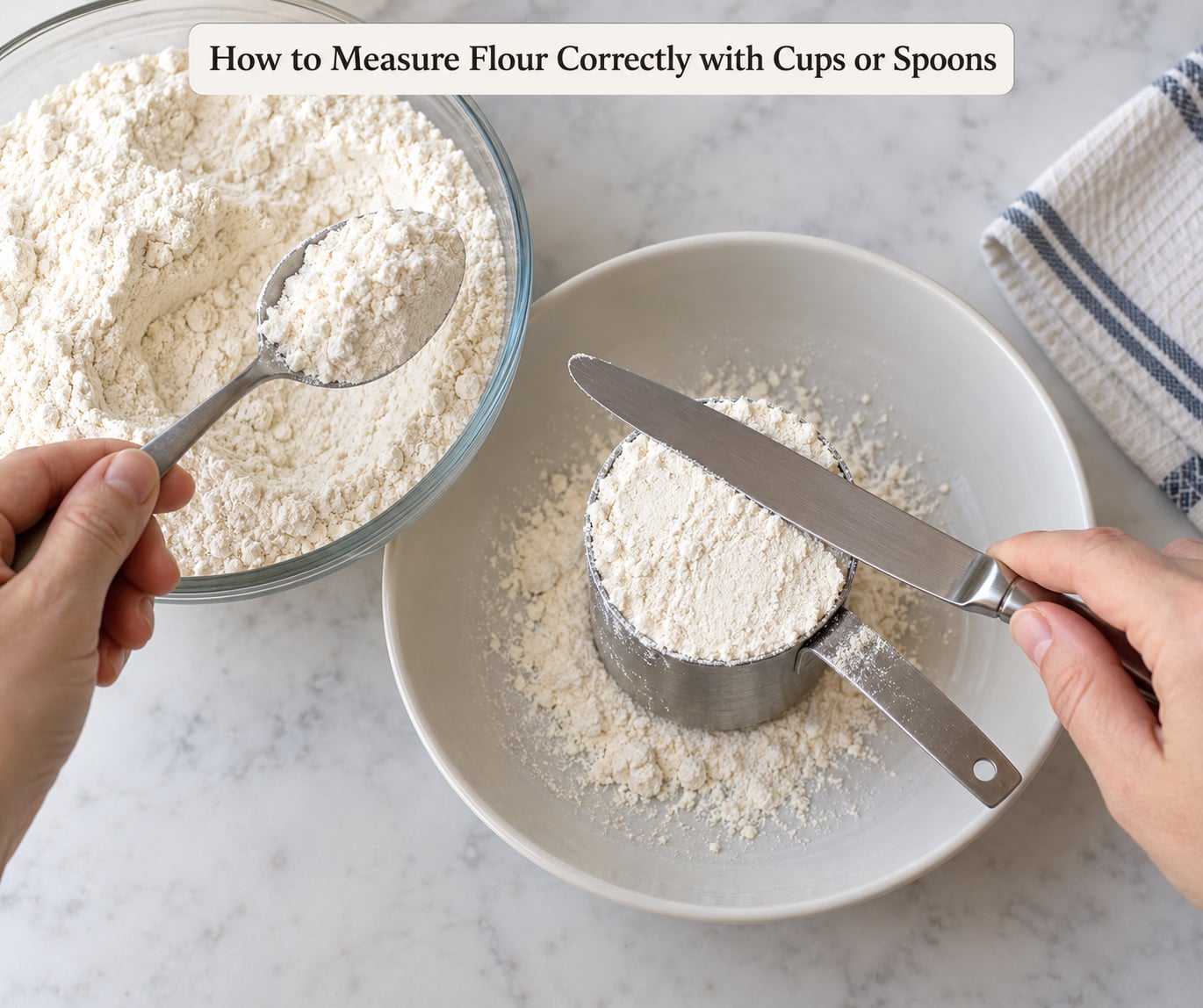
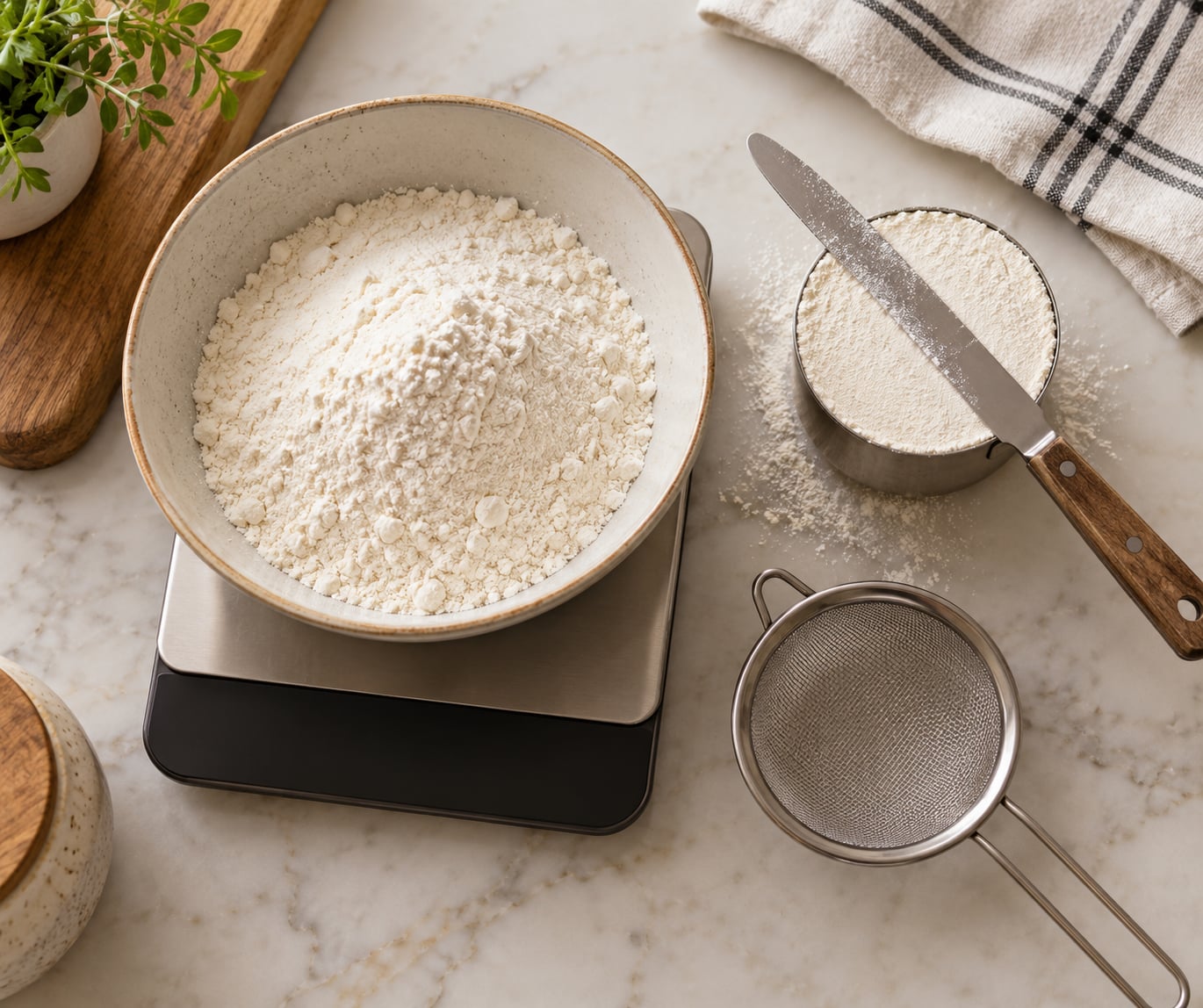
This is the method to use when you have no scale. It lands around 134 grams per cup, which is roughly 12 percent over the target, so if you can weigh flour, do. But it is a consistent 12 percent, and consistency is what makes a recipe repeatable.
- Fluff the flour with a spoon or your hand straight from the bag. Loosen any clumps that have settled during shipping or storage.
- Spoon the flour into the measuring cup. Do not pour directly from the bag, and do not shake the cup to settle the flour.
- Mound the flour above the rim until it holds a soft heap.
- Level the top with the back of a knife or a spatula, moving it in one direction.
Two details matter more than the rest. Fill over a larger bowl or a sheet pan, not over your mixing bowl, so a spilled heap does not quietly go into the recipe. And level across the rim rather than tapping it, because tapping settles the flour and puts you back where you started.
For small amounts under a tablespoon, use measuring spoons and fill them the same way, then level with the back of the knife. Never scoop a spoon of flour the way you scoop salt; a rounded spoon of flour can be 8 grams and a heaped one closer to 11, which matters in a dough or a crumb coating.
How to Handle Different Types of Flour
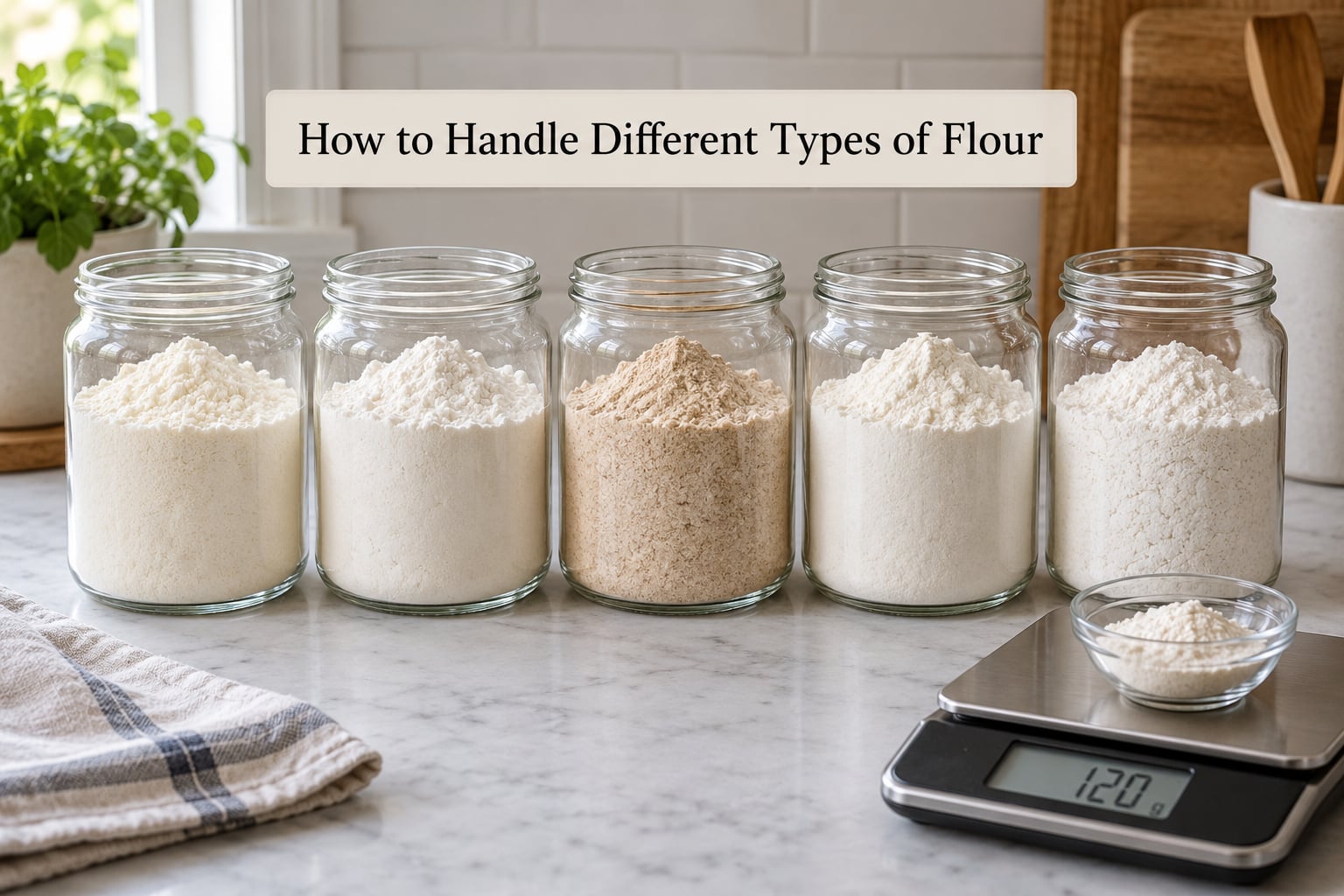
One cup is not one cup across flour types. If a recipe gives grams, use the grams for that specific flour rather than converting from a cup figure you found on another site. This is where a lot of the confusion about weighing comes from, and the fix is simply to stop converting and start trusting the recipe.
| Flour type | Grams per level cup | Notes |
|---|---|---|
| All-purpose | 120 g | The reference number most recipes assume |
| Bread flour | 127 g | Heavier per cup because of more protein and bran |
| Whole wheat | 113 to 120 g | Dense and coarse; weigh it if you can |
| Cake flour | 113 g | Finely milled, so less fits in the same cup |
| Self-rising | 120 g | Already contains leavening and salt; do not add more |
So a cup of bread flour and a cup of cake flour differ by about 14 grams, which in a lean dough is enough to make the difference between a springy crumb and a tight one. If you swap flours within a recipe, convert by weight rather than counting cups.
Follow the recipe author’s stated method when one is given. A recipe tested with spoon-and-level volume was built around whatever number came out of that method, and measuring by grams instead is not automatically more faithful to it. If the recipe gives grams, that is the method it was tested with.
Common Mistakes
Scooping and shaking from the bag. This is the big one. The spoon drives air into the flour and packs it, the cup holds more than a level cup should, and shaking compacts it further. It measured 173 grams per cup in testing, 53 grams over. Fix: fluff, spoon, level, every time.
Measuring over the mixing bowl. You fill a heaped cup, knock a little off on the way down, lose a bit on the rim. Fix: fill over a spare bowl or the sink-side of the counter.
Using a liquid measuring cup for flour. The spout and the wide base mean a cup line there holds well under a true cup. Fix: dry measuring cups for anything dry, liquid cups for anything liquid.
Not leveling, or leveling by tapping. A heaped cup adds flour; a tapped cup packs it. Fix: one pass of the knife across the rim, no tapping.
Rounding instead of leveling. A rounded or heaped cup of flour is 20 to 30 grams over a level one. Fix: level every time, even when the recipe says “about”.
Sifting in the wrong order. Sift first, then measure. Sifting after measuring only aerates the top layer and leaves a compressed block at the bottom of the cup.
Extra flour does real damage. Cookies turn cakey and puffy because there is not enough liquid to hydrate the extra flour, so the dough spreads less and puffs instead. Cakes and muffins go dense and heavy. Pie and pastry dough gets dry and crumbly and cracks when you roll it. Bread dough stiffens, proofs more slowly, and bakes into a tight crumb. A dozen extra grams rarely ruins a cake outright, but it is why a recipe that worked once fails the next time.
If you already overdid it, adjust rather than dump the batch. For cookie dough, add a tablespoon of butter and a tablespoon of sugar, rest it 20 minutes in the fridge, and bake; the added fat keeps the cookies from going cement-like. For a cake or quick bread, add liquid a spoonful at a time until the batter drops off the spoon in a slow ribbon. For dough, add a splash of water and knead; you cannot take flour back out, but you can bring hydration back up.
Tips for Consistent Baking Results
- Store flour airtight and cool. Moisture makes it clump and behave unpredictably, and heat drives off the starches that keep it dry. A sealed bin is enough; rice in the corner is optional.
- Write weights into your own recipes. Once a bake comes out right, note the gram weights and the method you used next to the cup amounts. Repeatable results come from repeating an exact procedure, not from a lucky scoop.
- Keep flour types in separate containers. Label them. Scooping bread flour out of the all-purpose canister on a busy morning is how a cake turns out tasting bready.
- Watch the weather. Humid days pack more moisture into the same cup, and at altitude flour expands, so a cup of flour is not quite a cup. Weighing solves both, which is another reason bread bakers live on the scale.
- Level more than once. Re-check the rim after filling, and level any cup you plan to hold for more than a minute.
- Use the scale for bread, pizza dough, macarons, and pastry. These have tight ratios where a few grams changes the outcome. Cookies and quick breads tolerate the volume method reasonably well.
Frequently Asked Questions
Is 1 cup of flour the same as 1 cup of water?
No. Water always weighs the same for a given volume, so a cup of water is always a cup of water. Flour is a loose powder that traps and releases air, so a cup of flour can weigh 113 grams for cake flour and 127 grams for bread flour, and it climbs higher when it is packed. That is the whole reason baking recipes in grams are more repeatable than volume recipes. Water can be measured by volume with confidence; flour cannot.
Do you measure flour before or after sifting?
Sift first, then measure. Sifting aerates the flour and breaks up small clumps, which is the point of the step in cake recipes. If you measure first and sift afterward, the top of the cup is airy and the bottom is still a compressed block, so the measurement is not consistent with the rest of the flour. The exception is when a recipe gives a weight and asks you to sift to that weight, in which case the gram figure is what to hit.
How do I measure 1 cup of flour accurately without a scale?
Fluff the flour with a spoon, spoon it into a dry 1-cup measure until it mounds above the rim, then level the top with the back of a knife in a single pass. Do not scoop from the bag, do not pour, and do not tap the cup to settle it. This lands at about 134 grams per cup, which is a little heavier than the 120 grams a cup should be. It is the best option without a scale and it is repeatable, which matters more than being perfect.
Which measuring tool is best for weighing flour accurately?
A digital kitchen scale that reads in grams and has a tare or zero button. Capacity matters less than people think; most home baking stays under 2 kg, but check the limit covers your heaviest mixing batch plus the bowl. More important is a platform wide enough for the bowl to sit flat, because an overhanging bowl gives an unreliable reading. Clean the platform between weighings, since stray flour and sugar add to every number after it.
How do I measure flour without scales or cups?
Honestly, you cannot measure it accurately, and any guide that says otherwise is selling you something. Without a scale or a standardized measure you are eyeballing, and eyeballing flour is exactly the habit that makes bakes unpredictable. The closest practical workaround is to pick up a cheap digital scale, which is the single highest-return tool in a home kitchen. Until then, use the fullest standard measuring cup you have and be consistent.
Why do my cookies turn out cakey and puffy?
Too much flour is one of the top two causes, with oven temperature being the other. Extra flour leaves the dough short on liquid, so it cannot spread and crisp in the oven and puffs instead, which reads as cakey. Check your measuring method first, then check your baking soda and the dough chill time. If you were scooping from the bag, switching to weighing at 120 grams per cup of all-purpose flour will likely fix it on the next batch.
Conclusion
Start here: when a recipe gives grams, weigh it. Put the bowl on the scale, press tare to zero, and add flour until the number matches. That single habit removes every variable that makes the same recipe behave differently from one bake to the next.
When you have no scale, fluff, spoon, and level with a dry measuring cup, and keep doing it the same way each time. And if you have been scooping straight from the bag, change that first; it is the mistake costing you the most flour and the least effort to fix.