Cheesecakes crack when the filling dries out, tightens and pulls apart faster than the cake can stretch with it. Almost always one of four things caused it: overbaking, overmixing, cooling too fast, or not enough moisture. Fix those four and the top stays smooth.
Learning how to bake a cheesecake without cracks is mostly about temperature and timing, not technique. It takes about an hour of baking plus an overnight chill, and the hardest part is genuinely the patience at the end.
Key prevention tips, in order of how much they matter:
- Bring the cream cheese, eggs and dairy to room temperature before mixing.
- Beat on low speed and add the eggs last, one at a time, just until combined.
- Bake in a water bath so gentle, even steam heat sets the custard from the outside in.
- Stop baking while the edges are set and the center still has a slight wobble or jiggle.
- Cool gradually in the turned-off oven with the door ajar before refrigerating.
- Let the cake chill completely before the first cut. A warm knife drags the top apart.
Table of Contents
- What You Need
- Step-by-Step: How to Bake a Cheesecake Without Cracks
- Step 1: Prepare the Pan and Ingredients
- Step 2: Mix the Batter Gently
- Step 3: Create a Water Bath
- Step 4: Bake at a Low Temperature
- Step 5: Cool the Cheesecake Slowly
- Step 6: Slice Without Creating New Cracks
- Common Mistakes That Cause Cheesecake Cracks
- How to Keep a Cheesecake From Cracking Before You Start
- Frequently Asked Questions
- What temperature should I bake a cheesecake in a water bath?
- Should you bake cheesecake with convection or conventional?
- How do I know if my cheesecake is cooked?
- Why is my cheesecake cracking while it cools in the oven?
- What happens if I overmix cheesecake batter?
- Can I fix a cheesecake that has already cracked?
- Conclusion
What You Need
Cheesecake is a short ingredient list, but three pieces of equipment do most of the work of preventing cracks.
- A 9-inch springform pan with a removable base. The removable side is what lets you cut the top without pulling the edge crust down with it. Cheesecake also bakes more evenly in a thinner cake, so a deep pan is a higher-risk choice.
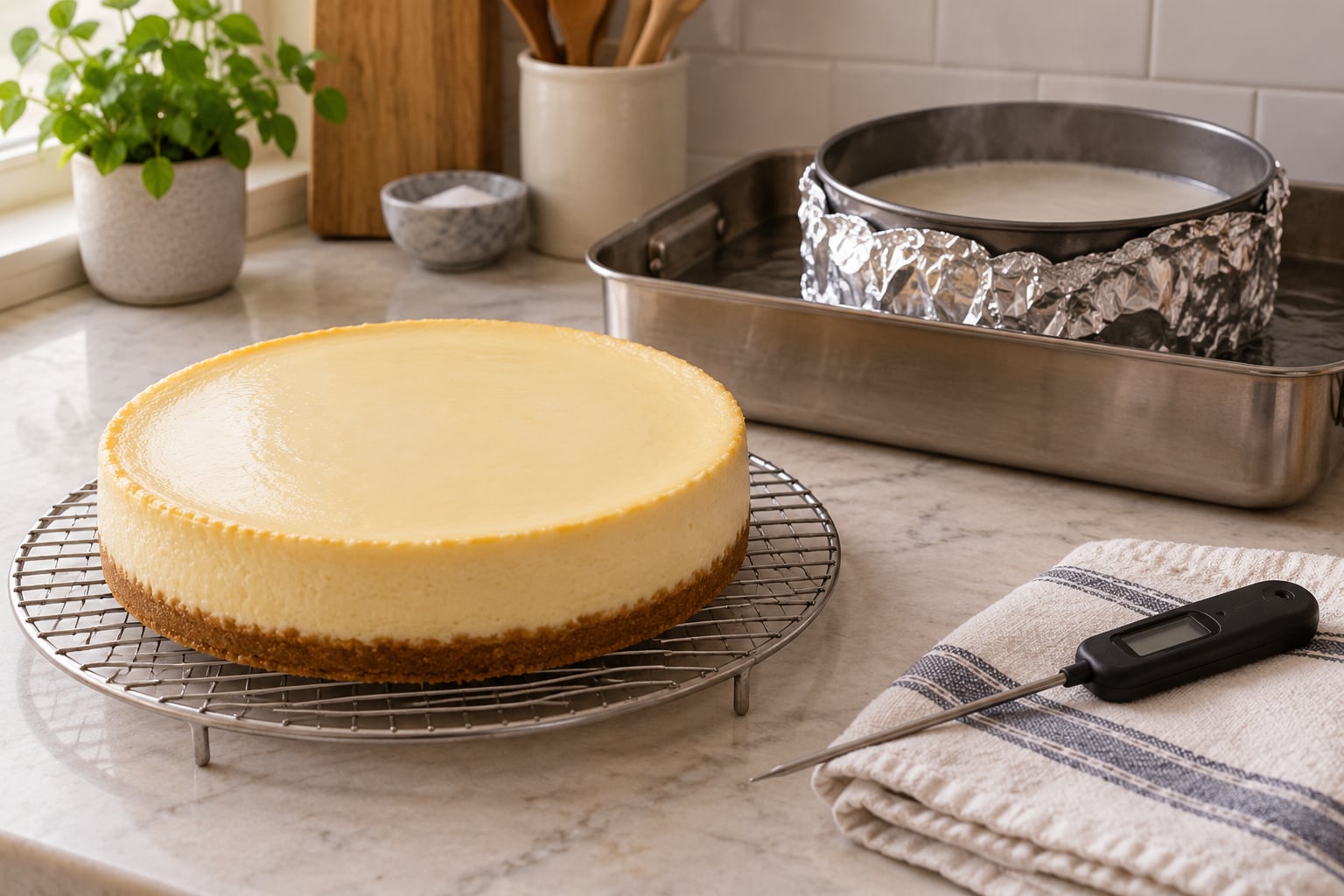
- A heavy roasting pan or oven dish large enough to hold the springform. This is your bain-marie, the water bath that surrounds the pan. If yours is too small, a separate pan of hot water on the oven floor does most of the same work.
- Two wide sheets of aluminum foil. You wrap the outside of the springform so boiling water in the bath cannot seep under the base and into the crust.
- A digital thermometer. An instant-read probe is what takes the guessing out of doneness.
- An oven thermometer, if you have never checked yours. A lot of the “my oven is just weird” complaints come down to an oven that runs 20 degrees hot.
- Full-fat cream cheese at room temperature, sour cream or Greek yogurt, sugar, eggs and a little vanilla or lemon zest. Sour cream or heavy cream is not optional decoration. That added fat and acid is what keeps the filling from drying out and tightening.
Skip flour. It thickens the batter slightly, but it makes a dry cheesecake and it does nothing to prevent cracks.
Step-by-Step: How to Bake a Cheesecake Without Cracks
Step 1: Prepare the Pan and Ingredients
Heat the oven to 150°C (300°F) on a conventional setting. Then wrap the outside of the springform in two layers of foil, pressing the foil up the sides and out over the top edge of the rim, and set it on a baking sheet.
Take the cream cheese out of the fridge 60 to 90 minutes before you mix. Cold cream cheese is the single most common reason a batter ends up lumpy and gets beaten harder than it should be, and lumps are where air pockets and weak spots start.
For the base, press graham cracker crumbs and melted butter into the pan with the flat of a cup, then chill it 15 minutes. A frozen base is firmer and less likely to shrink away from the side of the pan, which is where side cracks usually begin.
Step 2: Mix the Batter Gently
Beat the softened cream cheese on low speed until it is completely smooth, then add sugar a little at a time. Scrape the bowl twice. Add the sour cream or Greek yogurt, then the eggs one at a time, mixing only until each disappears into the batter.
That is the whole mixing technique. Overmixing pushes air into the batter, and air pockets expand unevenly in the oven and then collapse as the cake cools, which shows up as a split across the top or a network of fine lines.
Once the batter is uniform, run a rubber spatula around the bowl and tap it firmly on the worktop two or three times to knock out the big bubbles. Strain it through a fine sieve if you want a glass-smooth top. Both of these beat adding flour.
Step 3: Create a Water Bath
Pour the batter into the chilled crust and tap the pan on the counter to settle it. Put the foil-wrapped springform inside the roasting pan, then pour hot, almost-boiling water into the outer pan until it reaches about halfway up the springform’s sides.
The water bath works like a buffer. Instead of dry oven heat hitting the outside of the pan and driving moisture out of the filling, the cheesecake cooks in gentle, even steam heat and sets slowly from the outside in. A gently simmering bath, not a rolling boil, is what you want.
Two safety points matter here. Use a rack that sits below the springform, and slide a spare baking sheet on the oven floor underneath so a spill never reaches the element. Never lift the roasting pan out while it is full of near-boiling water; take the springform out with oven mitts instead.
If the water drops below the halfway mark during the bake, top it up with more hot water. You cannot do that with the oven door open for long, so check through the glass rather than opening up.
Step 4: Bake at a Low Temperature
Bake at 150°C (300°F) conventional for 55 to 70 minutes. On a convection oven, drop to about 125°C (250°F), a reduction of roughly 25°C or 45°F, because the fan adds about 20 to 25 degrees of effective heat.
You are looking for the edges to be set and the center to still have a slight wobble or jiggle when you nudge the pan. If you bake until the center is firm, the filling loses too much moisture and will split as it cools. That is the single most common reason a cheesecake cracks.
For a number rather than a wobble, aim for 65°C (150°F) in the center and no more than 79°C (175°F) about an inch in from the edge. Anything past 175°F at the edge means overbaked.
Do not open the oven door for the first 40 minutes. Every opening drops the temperature and lets the skin on top set unevenly, and drafts across the pan are enough to start a crack.
Step 5: Cool the Cheesecake Slowly
Turn the oven off and leave the door ajar with the cheesecake still in the water bath for one hour. Then take the springform out, sit it on a wire rack, and leave it at room temperature for another hour.
Cracks that appear during cooling are normal physics, not a mistake you made at the mixing stage. The outside of the cake sets first and contracts as it cools. If the interior cools and shrinks at a different rate, the top skin has to split to let go of that tension.
Once the cake is close to room temperature, refrigerate it uncovered for at least four hours, ideally overnight. Chilling firms up the filling so it holds a clean line when you cut it.
A leftover trick that works: switch the oven on for a minute or two, heat a cup of water until steaming, switch it off, and let the cheesecake cool inside with the door shut. The small amount of trapped warmth and steam slows the cooling even further.
Step 6: Slice Without Creating New Cracks
Run a sharp knife under hot water and wipe it dry between every single cut. A warm blade glides through the set filling; a cold one drags and tears it.
Cut from the center outward in straight lines, then cut those slices in half. Wiping between cuts matters more than knife sharpness. Once every slice is cut, run the knife around the outer edge to free the side crust from the pan before lifting a portion out.
Common Mistakes That Cause Cheesecake Cracks
Here is where the crack appeared and what actually caused it. Almost every split falls into one of these four buckets.
| Where the crack is | Likely cause | Fix it next time |
|---|---|---|
| One long split across the top | Baked too long or too hot | Pull it 10 minutes earlier and check with a thermometer |
| Split that opened while cooling | Rapid cooling, or a draft across the pan | Cool in the turned-off oven with the door ajar for a full hour |
| Crack hugging the side of the pan | The edge crust shrank away from the pan wall | Chill the crust first, and don’t stretch the parchment up the sides |
| All-over network of fine lines | Overmixed batter full of air | Mix on low, add eggs last, tap the bowl |
| Puffed-up dome that collapsed | Oven far too hot, often convection at full temperature | Reduce 25°C for convection and verify with an oven thermometer |
| Rough, grainy surface with a crack | Not enough moisture in the batter | Add sour cream or Greek yogurt, and use a water bath |
Three other mistakes come up constantly. Flour is one of them, and it does not work: it makes the filling dry and crumbly without fixing the split. Cooling the cake on the worktop and only then refrigerating it is the second, because the centre loses heat too fast while the skin is still warm and flexible. The third is skipping the water bath and hoping the oven runs cool enough.
How to Keep a Cheesecake From Cracking Before You Start
If you have time for one habit, make it the water bath. In side-by-side baking trials it is consistently the strongest single method, with cake strips a distant second and a pan of hot water on the oven floor a solid third.
| Method | How it works | How well it works |
|---|---|---|
| Water bath in a roasting pan | Hot water around the wrapped pan gives gentle steam heat | Very effective, the most reliable option |
| Pan of hot water on the oven floor | Steam in the oven without any risk of leaking into the cake | Effective for most cakes; a good small-kitchen workaround |
| Cake strips wrapped around the pan | Damp strips slow the outer edge from cooking and drying out | Helps with side cracks, less help with a split top |
| Baking with no protection | Dry oven heat pulls moisture out of the filling | Works only with a low temperature and careful timing |
Bakers on r/Baking who switched to the oven-floor steam pan reported a first crack-free cake, which matches what the method is supposed to do. If you have no roasting pan at all, put a deep pan of hot water on the lowest shelf and bake the cheesecake on the rack above it.
Do you need to wrap the springform even when you use a water bath? Yes. Foil stops water wicking under the base seam and sitting in the biscuit crust, which is the mess people worry about most.
Frequently Asked Questions
What temperature should I bake a cheesecake in a water bath?
Bake at 150C (300F) on a conventional oven setting, or about 125C (250F) on convection. The water in the bath should be hot and gently simmering, never a rolling boil. Most 9-inch cheesecakes need 55 to 70 minutes at that temperature.
Should you bake cheesecake with convection or conventional?
Conventional gives you more control and is what most cheesecake recipes are tested on. Convection works fine if you drop the temperature by roughly 25C or 45F to compensate for the fan. Baking convection at full recipe temperature is a common reason cheesecakes puff up and then split.
How do I know if my cheesecake is cooked?
The edges should be set and the center still wobbles slightly when you nudge the pan. With a thermometer, aim for 65C (150F) in the center and no more than 79C (175F) about an inch in from the edge. A centre that wobbles straight out of the oven is correct. It sets as it chills.
Why is my cheesecake cracking while it cools in the oven?
The outside sets and contracts first while the inside is still hot and soft, so the set top skin has to split to release that tension. Slow the cooling down: leave the cake in the turned-off oven with the door ajar for an hour, then on a wire rack for another hour before you refrigerate it.
What happens if I overmix cheesecake batter?
Beating pushes air into the batter. Those air pockets swell in the oven and collapse as the cake cools, which leaves a sunken top and a network of cracks across the surface. Beat the cream cheese on low until smooth, add eggs one at a time, and stop as soon as the batter looks uniform.
Can I fix a cheesecake that has already cracked?
Yes, and it is still perfectly good to eat. Warm a metal spatula under hot water, wipe it dry, dip it into the crack and press the softened filling back together in short strokes. Chill it again for 20 minutes to set, then cover it with fruit, whipped cream, chocolate sauce or your own ganache.
Conclusion
Start here next time: cream cheese at room temperature, mixing on low with eggs added last, a water bath, a low oven, and out of the oven while the center still jiggles. Then cool it slowly and let it chill before you cut. Those five habits fix most cracked cheesecakes before the first one appears. A split cake is still perfectly edible, so if one shows up anyway, patch it with a warm spatula and cover it with fruit or ganache.